
People are a company’s most important asset. And making sure that employees stay connected and engaged at work often rests on HR’s shoulders.
New technologies enable HR teams to spend less time on manually-intensive administrative work. In turn, that creates more time to focus on people and ideas to help the business achieve strategic goals.
When the company’s HR leader learned about ChartHop, he saw right away how it could help his team be a better partner to the business by working more efficiently and delivering faster, more streamlined insights.
The HR leader was responsible for keeping the company’s org chart current. And he was doing it all in PowerPoint.
That meant manually updating minor changes like title updates and promotions, and things got complicated quickly when the company embarked on larger changes that resulted in new reporting lines, restructurings, and recruiting efforts. At that point, he spent so much time dragging around boxes and shuffling people and teams across slides for meetings and presentations that it was all-consuming.
Specifically, he spent 4-5 hours a week manually updating the org chart. Beyond costing $15K a year in lost productivity, this effort also kept him from sharing key people insights when they mattered.
If a VP or director needed an org chart and it wasn’t already fully up to date, HR couldn’t produce one on the spot. Without accurate information at the right time, workforce planning became disjointed.
Managers built hiring plans in silos and brought them to HR meetings without full context on what was happening across the company. The team would then try to rework those plans live in PowerPoint, sometimes even sketching sensitive changes by hand. The process was slow and inefficient, and the team knew they needed something better.
What the company needed was a solution that enabled them to visually represent their organization, keep pace with organizational changes, securely house their data and align their teams to one source of truth for that data. That’s where ChartHop stepped in.
Implementing ChartHop delivered immediate benefits. The HR team finally had a tool that allowed them to spend less time and energy on manual, administrative work and more time using their people data to drive strategic insights for the business.
The HR leader now puts that reclaimed time toward higher-impact projects like recruiting, workforce planning and internal training, the core work of his role.
ChartHop fundamentally changed the way the company approaches organizational design, and it all started with having the right information at the right time.
When the team previously poured hours of time and energy into PowerPoint org charts, they also naturally exposed their work to manual error. Now, when anyone needs information on current team and org structure, they can trust ChartHop as a source of truth that will provide the most up-to-date and relevant information.
Creating and updating the org chart now takes about a minute. Clicking on any manager instantly shows their team, and a full view of the organization is always available.
ChartHop has also helped the company plan more strategically. Previously, its workforce planning process involved siloed and disjointed workflows, hand drawings of proposed structural changes, and piecemeal exchanges of information over email and ad hoc meetings.
Now, the HR team has the resources they need to be a true strategic partner in planning, and to do so proactively. With all of the company’s people data in one place, they save time and can lay out clear options for what individual teams, or the company as a whole, could look like.
For example, when the HR leader identifies opportunities for changes to hiring plans, he can use ChartHop data to build a solid business case and move the organization forward. That means rather than waiting for individual managers or team leads to propose headcount changes, he can use ChartHop to proactively forecast hiring plans, collaborate with managers and get their feedback in real time, and then align the team to those changes.
Managers who review proposed changes in ChartHop find it easy to map out plans for the future, and incorporating their feedback takes seconds.
Critically, ChartHop’s workforce planning tools not only gave valuable time back to the HR team, but also led to a more intentional hiring plan that saved $450K in reduced headcount spend.
For this HR leader, HR’s role in any thriving business is to be a true partner to the organization. That means proactive, data-informed workforce planning.
However, getting there is not always easy. It requires technology that automates manually-intensive, administrative work to provide time and clarity that can be spent on delivering high-impact solutions.
ChartHop gave the team one place to build plans and see their impact on the business in real time. Conversations that once lived in long email threads, PowerPoint decks, and hand-drawn sketches now happen in a shared view, where the team can propose changes that move the business forward.

Spirits
Fully distributed


Effective headcount planning strategies allow organizations to grow intentionally by bringing the right skills into the business at the right time. These 4 strategies provide a blueprint for getting started.

Shopping for org chart software doesn’t have to be a hassle. Look for a solution that’s intuitive, easy to use, and designed with you in mind.
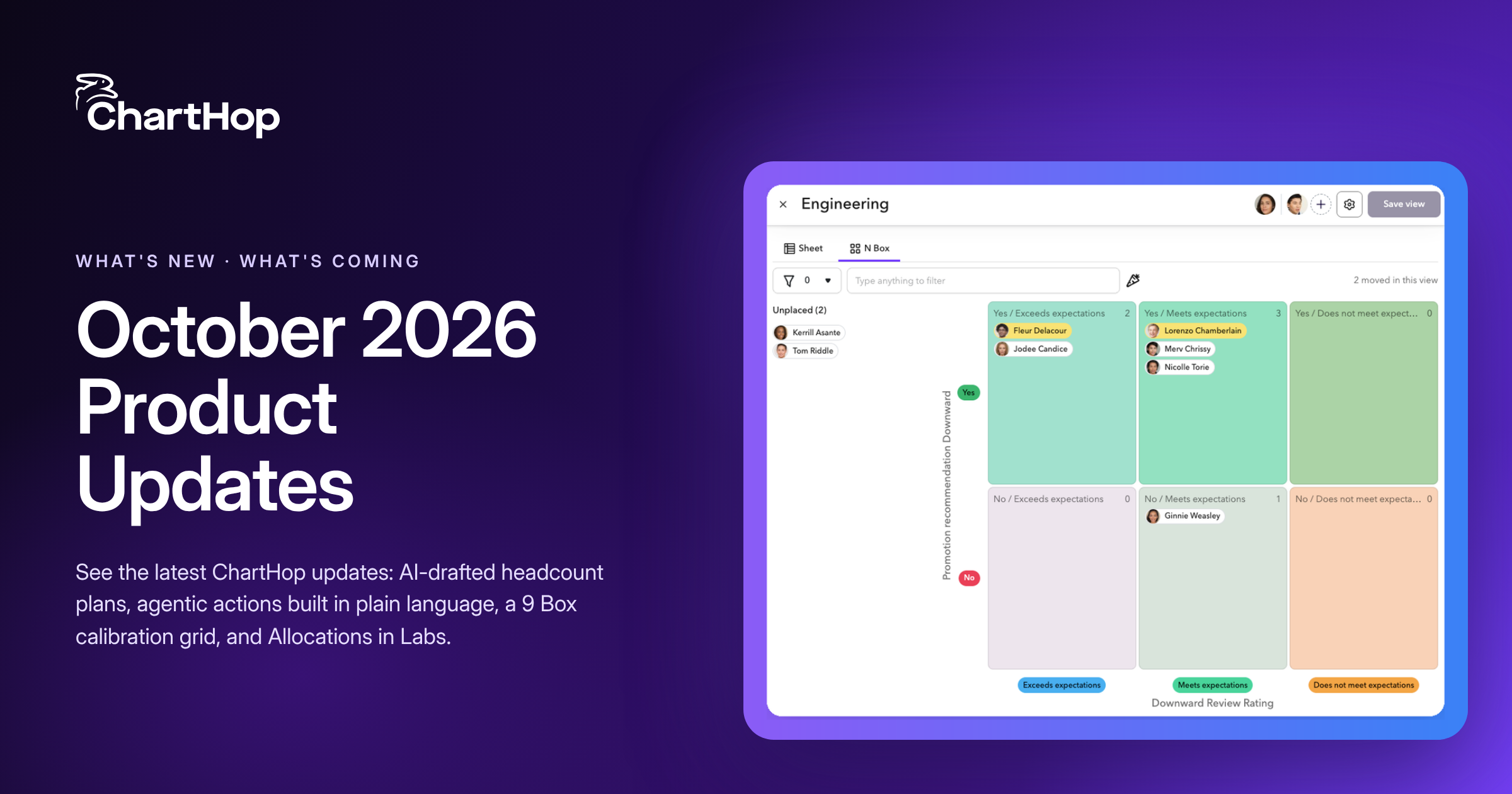
See the latest ChartHop updates for October 2026: AI-drafted headcount plans, agentic actions built in plain language, a 9 Box calibration grid, and Allocations in Labs.
AI agents that do real work, governance that got specific, and why context matters more than data. Our five takeaways from HR Tech 2026 in Las Vegas.
Heading to Gartner HR Symposium/Xpo in Orlando? Our picks for sessions on workforce planning, org design and AI in HR, plus where to find ChartHop at Booth 220.


