Most companies don't think of their HR software as a statement of cultural values. They think of it as an administrative necessity. Kelsey Browning has a different read on it.
Kelsey is a People Ops executive who has built HR functions from scratch inside high-growth companies. She was an early ChartHop customer, running a full RFP in 2021 while standing up a people operations function at an 80-person Series B startup. At Transform 2026, ChartHop CEO Ian White sat down with Kelsey to talk through that decision, what she got right, and what she's seen change as AI enters the picture.
When Kelsey joined Shogun as a Series B startup, the company needed a way to make sense of its people data. Compensation planning was coming, and it was going to be the company's first real moment of establishing a compensation philosophy across a global team. Doing that in spreadsheets wasn't just inefficient, it was a liability.
ChartHop stood out in the RFP for two reasons. First, the compensation module was ahead of where the rest of the market was at the time. Second, the combination of custom fields, an analytics layer, and richly configured employee profiles gave Kelsey's team a real foundation to build on, not just a place to store records.
What followed was more than just cleaner processes. The workforce planning module helped Kelsey's team run quarterly headcount reviews with real rigor. That effort eventually surfaced a decision that would have been much harder to make in a spreadsheet: the data showed that one of the company's business lines was generating negative ROI on people spend, and the company wound it down. Clean data, applied consistently, led directly to a smart business decision.
Vendor selection usually comes down to features, price, and implementation timeline. Kelsey puts something else on the list: Familiarity and ease of use.
Most employees touch HR systems once a quarter, maybe less. The HR team lives in them, but everyone else is just passing through. A fragmented, best-of-breed stack means every task is a relearning exercise. People can't self-serve, questions pile up on the HR team, and the moments that actually matter get buried in “how-do-I-do-this” requests. For Kelsey, the goal is one system people already know — so when something important comes up, they can handle it without asking anyone for help.
How do we make it really easy for people to self-service, so the HR team doesn't have to answer as many questions and I can build efficiencies instead?

Kelsey saw an early demo of ChartHop AI Pro at Transform and was excited about what it unlocks.
She described a workflow she'd run in ChartHop: asking in natural language for median and average age split by gender across the US and Canadian workforce, and getting an immediate answer. That kind of output changes what you do next. A workforce skewing young in a particular market means parental leave demand is coming, which makes it important to get a vendor like Tilt or Sparrow in place now, before you're managing 15 complicated leave cases in a year.
But what stood out about AI Pro specifically was what it did beyond the answer.
Where a lot of AI modules stop is they might just create the thing, answer a question, generate a policy. But they won't take the next step of: let's create a workflow based on this. That's something very unique to ChartHop from what I've seen.
Faster answers are table stakes. What Kelsey describes is AI that takes accurate feedback, acts on it, and builds out the workflow, so the insight actually goes somewhere instead of getting lost. And it does that in a way that reflects how your organization actually works, not just what's technically possible.
If you're evaluating HR systems at a growth-stage company or wondering whether your current stack actually reflects how your organization wants to operate, discover how ChartHop approaches it. Or explore the ChartHop resource hub for more on building a people operations function that scales.


Airbnb’s recruiting ops and technology leaders explain how remote work reshaped workforce planning, why AI’s real value is removing tactical friction, and why your data layer determines everything.
Zapier’s Chief People & AI Transformation Officer explains why annual planning cycles are broken, why spreadsheets can’t keep up, and what it actually looks like to make workforce decisions in real time.
Organizational intelligence is what a company knows about itself, connected in one place and current enough to decide on. Here is where the term came from, the five layers of data it spans, how it differs from workforce intelligence and people analytics, and the test a system should pass before it uses the name.
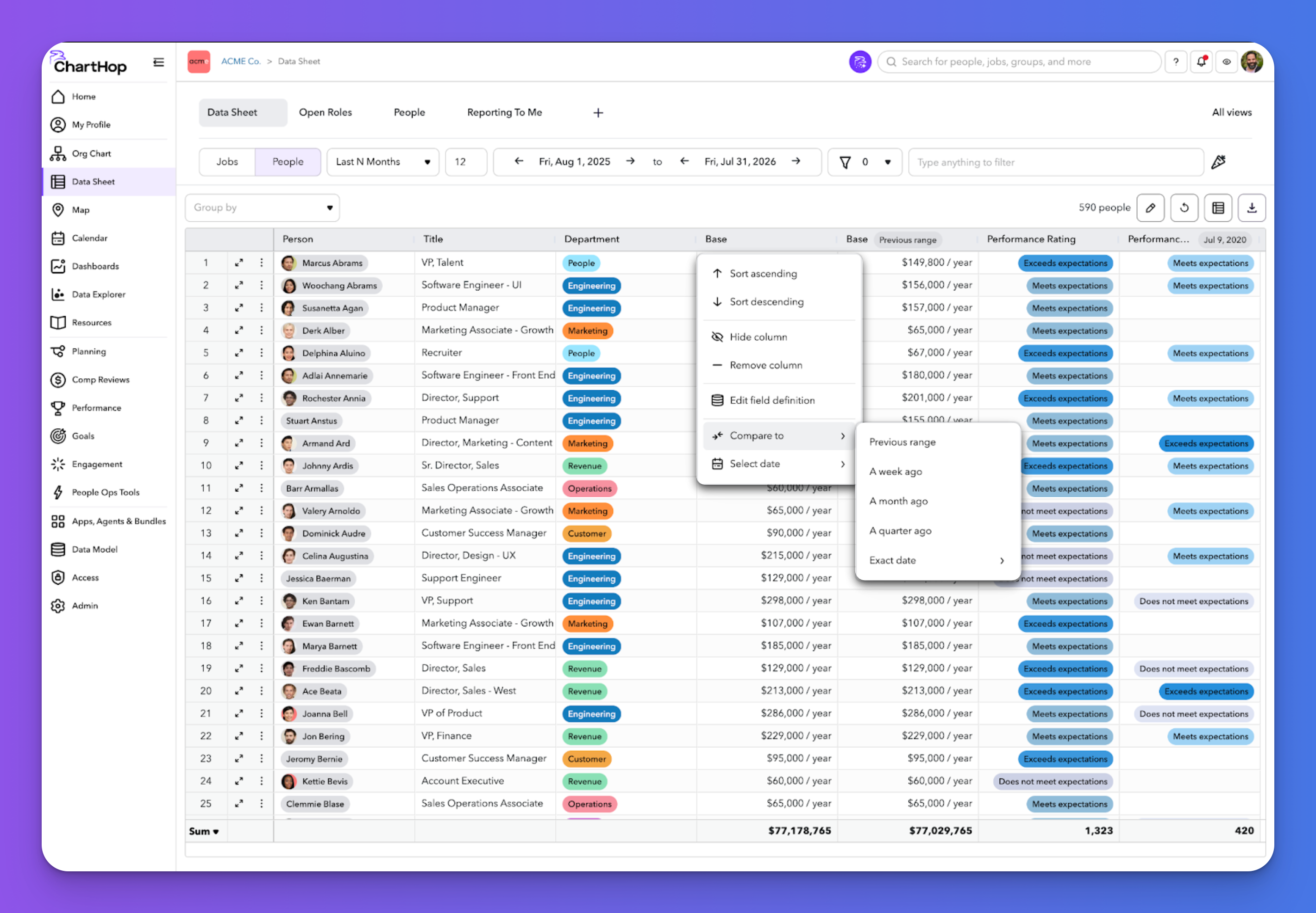
See the latest ChartHop updates for September 2026: time-based columns in the Data Sheet, automated time off milestone awards, fully translated goals, and a smarter scenario org chart.
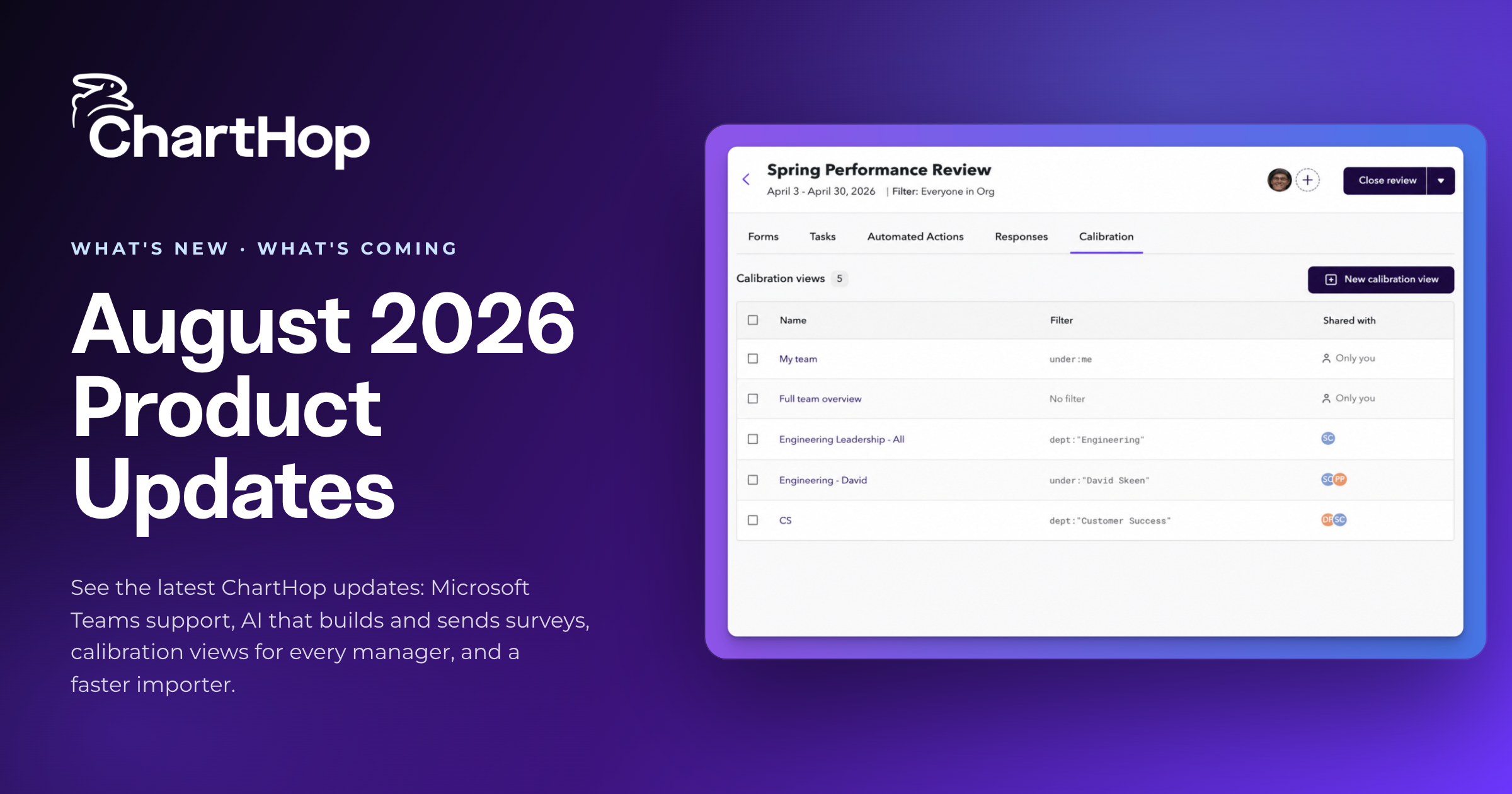
See the latest ChartHop updates for August 2026: Microsoft Teams support, AI that builds and sends surveys, calibration views for every manager, and a faster importer.