
The company’s talent leader was brought on to build out and lead the Talent function. To have the most impact, they looked for a people operations platform that could consolidate headcount planning, align with Finance, and eliminate manual tasks in one place.
The company realized that its people data systems and headcount planning process left much to be desired. While the People team had access to information that lived in their HRIS and ATS, business partners and employees across the organization didn’t have that same visibility because the data was siloed.
In the absence of a centralized place to collaborate, the People team had to resort to sending out separate spreadsheets for each department head to submit proposed headcount changes.
Historically, the team converted fields manually so that information matched across departments and could then be pulled into a master hiring plan for the entire organization. This process was inefficient and almost impossible to keep organized, resulting in variations to the overall plan that lived in different places.
Not only was this a painful and time-consuming process for the People team, but it also got in the way of effective collaboration with Finance. Without access to an aligned hiring plan, Finance was left to estimate target salaries and use placeholder start dates in an effort to forecast the budget.
Spurred on by a big hiring year, the People team had an immediate need to connect their various people tools and remove manual updates for forecasting headcount. This led them to look for a unified people operations platform where all business partners and stakeholders across People and Finance had access to the people data needed to make informed decisions, collaborate on headcount plans, and take action to achieve business goals.
Implementing ChartHop allowed them to do all of that while navigating a changing macroeconomic landscape.
Previously, recruiters were responsible for creating their own draft roles in the ATS and managing all the associated details, such as anticipated start date and target salary. The lack of standardization resulted in a lot of variance in the data for each open requisition and made it hard to track progress and budget against the overall hiring plan.
Once ChartHop was rolled out across the organization, everyone could see the hiring plan, including anticipated start dates and which recruiter and hiring manager owned each requisition. That transparency solved many of the team’s pain points and helped people plan ahead as the company grew.
Today, with ChartHop, the process is much more streamlined, saving the People team time spent on manual tasks. Once all stakeholders agree on the headcount plan and a job is approved, the talent leader simply clicks ‘Active’ in ChartHop. Through a direct sync, the headcount data then pushes into the company’s ATS with the same template every single time. That’s it. With one click, there’s consistency across all open roles, and everyone has confidence that each requisition matches what Finance approved, saving the Recruiting team hours of manual work.
Just how much time was the People team able to save? The team reports a collective average of up to 8-10 hours per week saved by eliminating manual data pulls from different systems, consolidating spreadsheets for headcount plans and building reports.
Manually updating a headcount plan for Finance and budget purposes takes far more time than most people expect. Every promotion, raise, hire, and departure has to be tracked, and across a growing company that adds up quickly.
And gone are the days when the People team manually exported data from HR systems to compile into spreadsheets, reformat with matching fields, and use VLOOKUPs and complicated formulas to run comparisons across tools.
By bringing all of their people data into ChartHop, the team can now quickly find trends, such as departure signals by gender, ethnicity, department and tenure, and use them to shape impactful processes and initiatives. Having these insights at their fingertips has replaced the need for a dedicated HR analyst, amounting to cost savings of $90k/year based on the national average for total compensation.
By turning people data into actionable insights, ChartHop helps the People team tell the story of their people and align to business goals.
People teams often know what needs to be done, but the business is focused on building products, and it can be hard to make the case for People priorities. Data is the most effective way to tell that story, and having those insights in ChartHop has given the team a clear way to show what matters and why.

B2B software
Hybrid
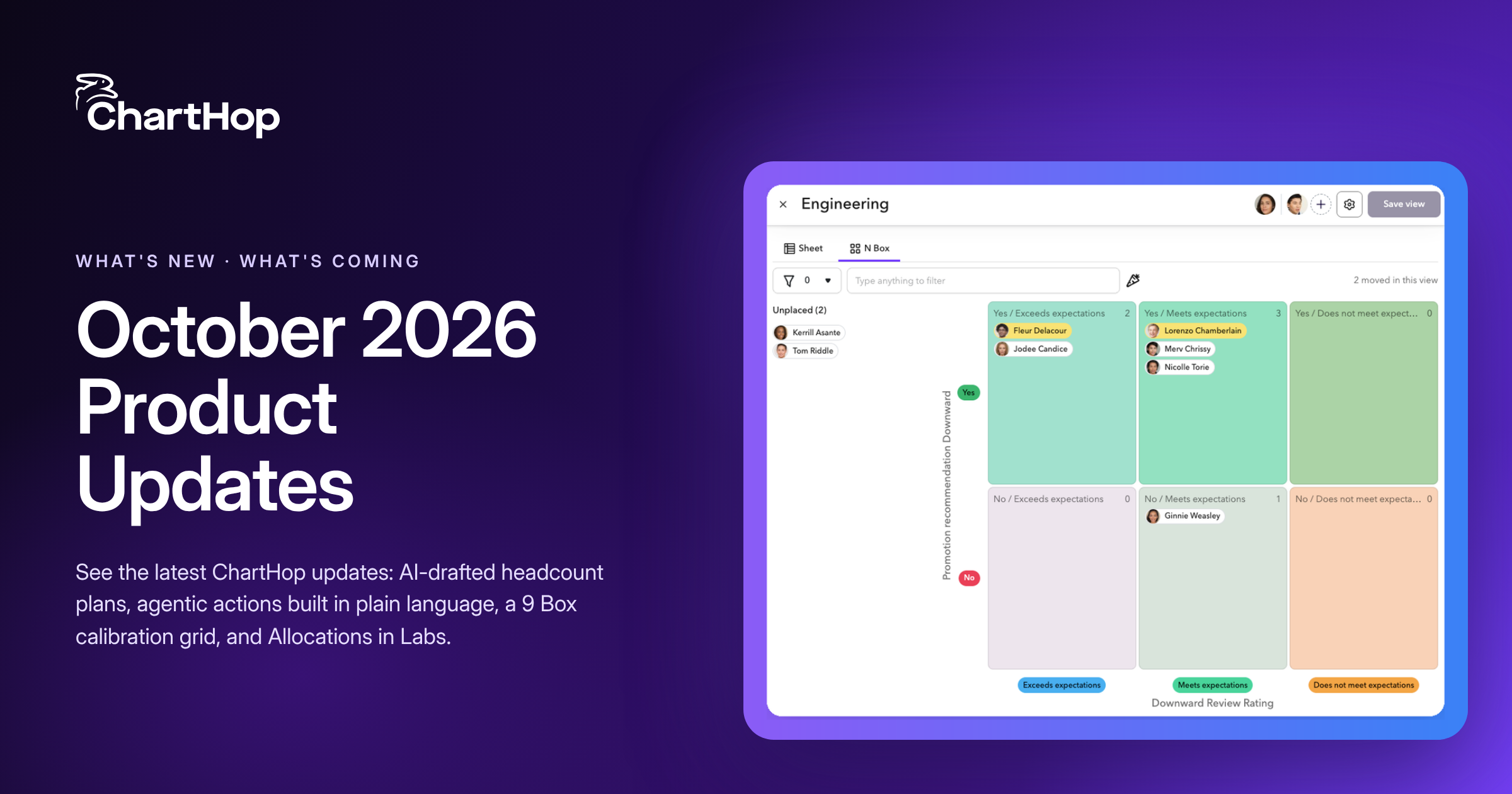

See the latest ChartHop updates for October 2026: AI-drafted headcount plans, agentic actions built in plain language, a 9 Box calibration grid, and Allocations in Labs.
AI agents that do real work, governance that got specific, and why context matters more than data. Our five takeaways from HR Tech 2026 in Las Vegas.
Heading to Gartner HR Symposium/Xpo in Orlando? Our picks for sessions on workforce planning, org design and AI in HR, plus where to find ChartHop at Booth 220.


