
Ask a room of HR leaders what they plan headcount in and you’ll get the same answer every time: Excel. I heard it again and again in Orlando last month, at a conference where nearly every session had AI in the title. That gap – between where the conversation is and where most teams actually are – ran through the whole week. Here are my key takeaways.
The theme I heard most often all week was about the time AI frees up. Most people are saving some, but very few organizations have decided what that saved time is for. As a result, the saved time gets repurposed into replying to emails, taking part in more meetings and putting out tactical fires.
The cost conversation around the use of AI was just as sobering. Gartner published research during the event finding that 77% of board members expect AI to deliver productivity and cost savings, yet just 3% of organizations exceed their cost savings goals through productivity.
The catch is that you can't redirect capacity you can't see. Many HR teams can't say with confidence where their people's time goes today, let alone where it should go next year. Intentional data-driven workforce scenario planning has perhaps never been more critical.
Skills came up in almost every session I attended, whatever the official topic, with two key themes.
First, more skills isn't the answer. Many companies have spent years building huge skills libraries that are largely unused. The more practical move is to pick the key skills that set your business apart and get very good at building those. Someone's willingness to learn matters more than a perfect checklist on day one.
Second, some skills fade if nobody uses them. When AI drafts the analysis, writes the first version and cleans the data, people stop practicing the judgment that goes with it. That's true for analysts, managers and new grads alike. If AI takes over the repetition, we have to find other ways for people to build that judgment, through simulations, apprenticeships or simply more coaching.
Several sessions made the same point: AI work doesn't have a go-live date.
Many of us learned HR technology through big system rollouts. You plan, you launch, you celebrate and you move on. With AI, the work is just beginning with the launch. Tools need tuning and agents need watching, as the work and data around them keeps changing.
Accountability came up again and again. When an AI tool gets something wrong, who owns it?
In my view, agents can act, but only people can be accountable. Give each AI agent a named human owner, some way to tell whether it's doing its job and a feedback loop, much like you would for a new hire.
AI governance is getting a lot of attention and it should. But I came away from the conference thinking judgment matters just as much. A policy can tell people which tools they're allowed to use and what data they can use. It can't tell someone whether the answer on their screen is right.
Judgment calls get made constantly, in every team: an analyst deciding whether a forecast makes sense, or a manager deciding whether to trust an AI summary of someone's performance. If people can't spot when AI is confidently wrong, no policy will catch it in time. When we talk about AI skills, judgment belongs at the top of the list. Knowing when to trust the AI output and when to push back is a critical skill that will safeguard companies and their growth. Yet, how do you ensure employees have this skill – in particular when so much of the work – the work that we learn and grow from – is getting automated?
Much of the AI conversation in HR circles is about employees: training, adoption, upskilling. Several conference sessions turned this around and asked about the people at the top.
Boards want AI results quickly, and senior leaders are being asked to redesign work they are further away from than ever. Many haven't spent much time with these tools themselves. It's hard to lead a change you don't understand, and easy to stall while you wait for a certainty that isn't coming.
This is where HR has real leverage. Succession planning, executive development and the performance bar for leaders are all ours to shape. If we expect managers to change how they work, we should be just as clear about what we expect from the leadership team.
Workforce planning was on everyone's lips, and most people I talked with shared they don't feel great about how they're doing it. Ask a room of People leaders what they plan headcount in and you already know the answer: spreadsheets. I have a lot of love for spreadsheets, but they are error prone and not secure: they break easily, Finance and HR each end up with their own version, and nobody fully trusts the number.
The cost of getting workforce planning wrong is real. Gartner's own prediction from the conference is that 30% of employees replaced by AI will be rehired by 2029 – often at a higher cost – if organizations don't overhaul workforce planning.
I've spent a big part of my career around people analytics, so I went into these sessions with high expectations. The mood was a mix of excitement and nerves. Everyone can see what AI could do for analytics teams. Far fewer can show what it has done so far.
I was glad the "dashboards are dead" idea didn't win the week. For people data especially, trusted, governed dashboards matter more with AI around, not less. What has to change is how they get built. Too many start with the data that happens to be available. The good ones start with a decision a leader has to make, and they come with enough context that the leader actually acts on it.
One topic I'd like to see get a lot more attention is succession planning – and this week's news that Nvidia's CEO stepped down with no obvious successor in place makes the point.
Succession planning is one of a board's core responsibilities, and HR leaders are the ones who make it work in practice: keeping it on the agenda, defining what the next leader needs to look like and developing the people who could step up. Boards say it's a priority, yet 30% of public company boards say they have no successor identified if their CEO left tomorrow. Below the C-suite the bench is often thinner still, and few companies connect succession to their workforce planning at all.
Most succession plans are built on today's org chart: who's ready to step into which box, and when. But if AI is changing the work, it's changing the boxes too. The leader you need in that seat in three years may be running a team that's part people, part agents, and making calls on AI investments the current person never had to make. A plan built around the role as it looks today can be out of date before anyone uses it.
There's a quieter problem underneath. A lot of today's leaders built their judgment doing the repetitive early-career work that AI is now taking over. If companies hire fewer junior people and automate the grunt work, where does the next bench come from? I don't think anyone has a clean answer yet.
If every session agreed on one thing, it was that technology is the easy part.
People are far more likely to back a change they helped shape, even when they don't love every part of the result. One of the simplest ideas I heard was to ask employees how they'd want something to work before you redesign it. The people doing the work usually know exactly where it breaks.
It also means talking about AI honestly. Much of the anxiety around AI is about what leaders will decide to do with it. Communicating more than feels necessary, admitting what you don't know yet and making it safe to flag problems all build the trust that adoption depends on.
This reminded me of the exceptional HBR article by John P. Kotter, Leading Change: Why Transformation Efforts Fail. The article identifies “undercommunicating the vision by a factor of ten” as a primary reason transformations collapse, and argues that a major change requires repeating the vision across every possible channel—town halls, newsletters, daily conversations—and backing those words up with visible leadership behavior.
One candid session I sat in was a Deloitte panel with Regions Bank. They described an AI rollout that started with the technology and skipped the people side, and how HR stepped in to fix it. Their approach for HR is "learn first, lead next": experiment inside HR first, then take what you learn to the rest of the business.
What stood out to me was the order they work in. HR has a seat at the table where AI decisions get made, next to Finance and technology, so people decisions happen alongside the technology ones instead of after them. They use data to decide where AI should start, and they think about hiring and redeployment before anyone has to talk about cuts.
While much of the conversation in Orlando was focused on very large companies, the ideas don’t only work at that scale - and a smaller company can typically move faster.
If I had to pick one place to start, it would be getting a single, live view of your organization that HR and Finance both trust. Nearly everything above depends on it. It's very hard to put AI where it matters, redesign work, plan succession or prove that anything worked when your org data lives in five systems and three spreadsheets.
That's what we were showing at Booth 220 in Orlando. ChartHop connects your HRIS, ATS, payroll, finance, CRM and other business data into a living model of your organization. People and Finance plan together, so you can model a reorg or a hiring plan and see the cost, spans and capacity before anything is announced. Leaders can ask questions about their org in plain language instead of waiting on a dashboard. And our AI agents work inside the same permissions as the people using them, with approvals and a log of every action, which is the kind of accountability I talked about above.
If you stopped by the booth, thank you. If you didn't, we'd be happy to show you what we were demoing.

Heading to Gartner HR Symposium/Xpo in Orlando? Our picks for sessions on workforce planning, org design and AI in HR, plus where to find ChartHop at Booth 220.
What stuck with me from Gartner HR Symposium in Orlando: where AI's saved time really goes, why judgment matters as much as governance, the succession planning gap, and why workforce planning needs a single view HR and Finance both trust.

Calibration should flow straight into pay. Here's which ratings should inform compensation, how to set target band positions and model the budget bottoms-up, and how to help managers explain the pay.
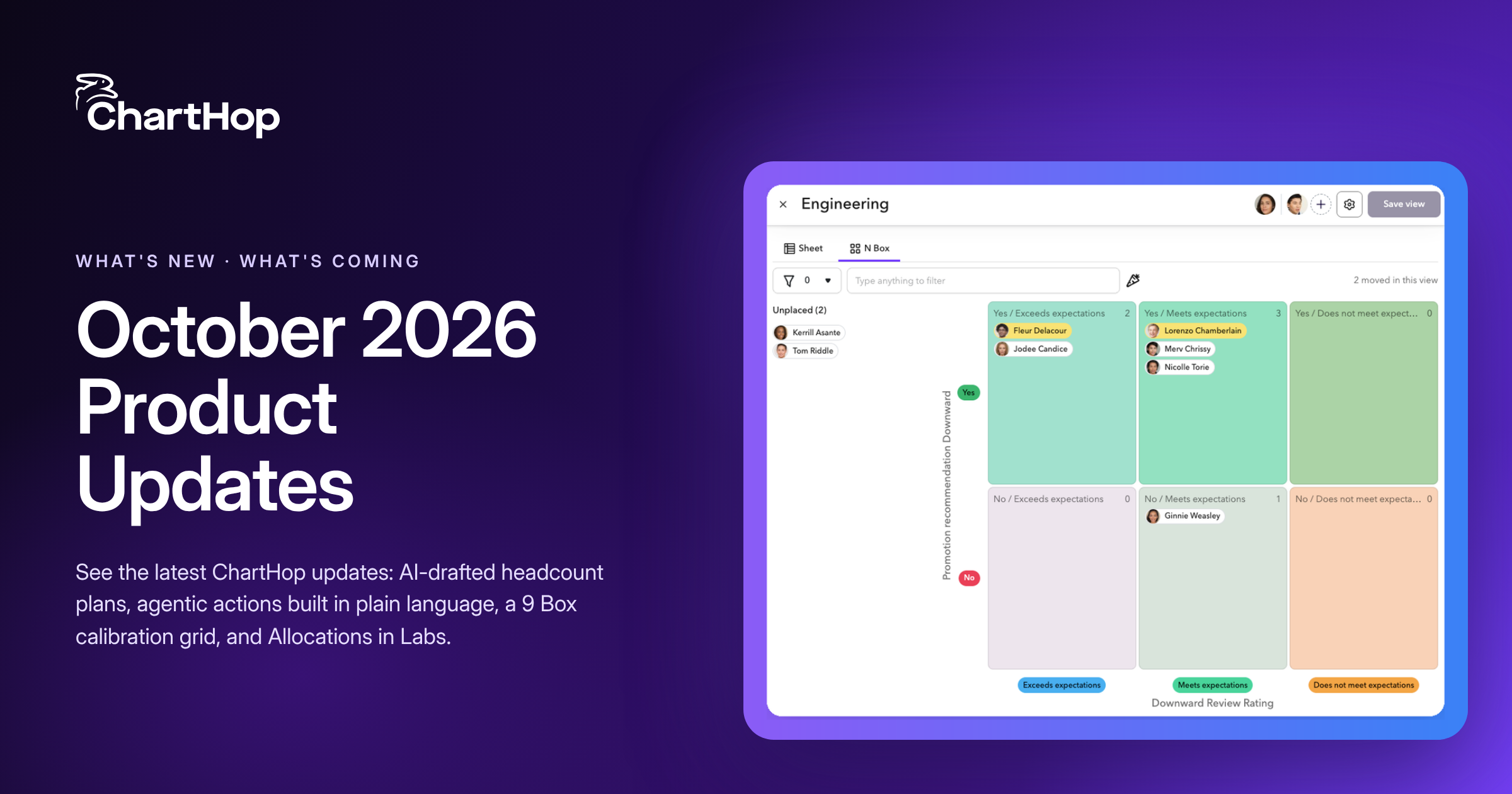
See the latest ChartHop updates for October 2026: AI-drafted headcount plans, agentic actions built in plain language, a 9 Box calibration grid, and Allocations in Labs.


