
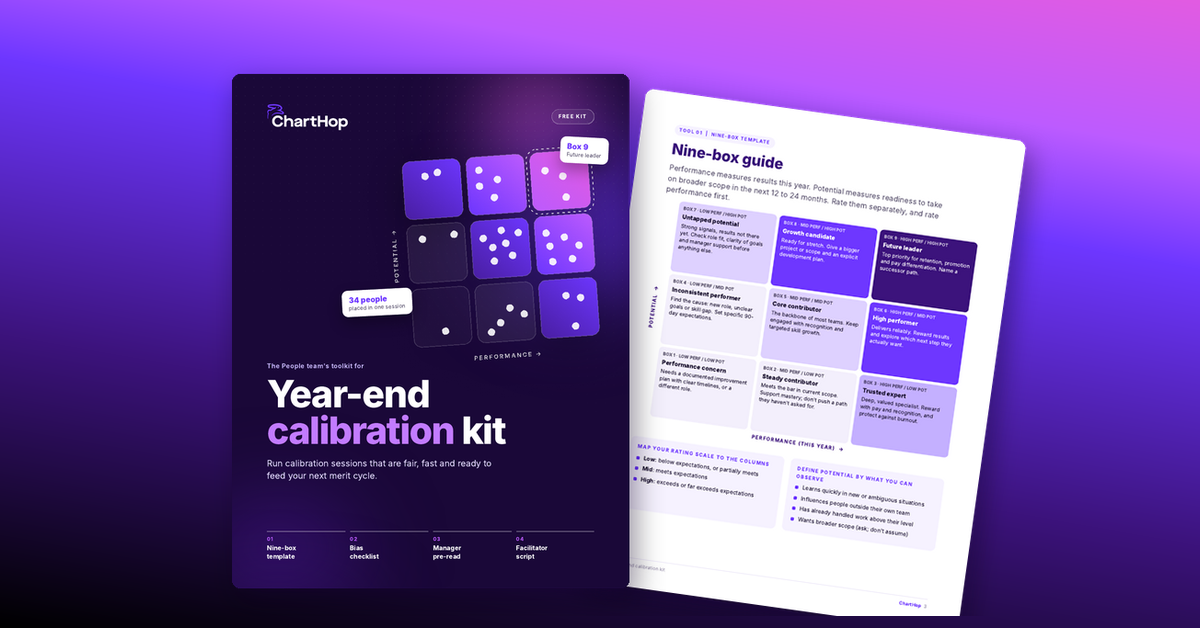
What you'll learn: What a calibration meeting is, why it matters before merit decisions, how to prepare managers, how to run a 90-minute session and how to carry calibrated ratings into comp. Free kit with a nine-box template, bias checklist, manager pre-read and facilitator script at the end.
A calibration meeting is where managers review each other's proposed performance ratings, with HR running the session, before those ratings are final. Each manager shares their ratings and the evidence behind them. The group challenges anything that looks inconsistent, and ratings get adjusted so an "exceeds" on one team means the same thing as an "exceeds" on every other team.
It usually happens after managers draft ratings and before ratings are shared with employees or turned into pay.
Managers rate differently. Some rate everyone high, some rate everyone in the middle and some are swayed by the last few weeks or by who they see in the office most. Research on performance ratings has found that more than half of the variance in a rating reflects the person giving it, rather than the person being rated (Scullen, Mount and Goff, Journal of Applied Psychology, 2000).
When those ratings drive raises, bonuses and promotions, inconsistency turns into unfair pay. Calibration is the step that catches it while it can still be fixed.
The single biggest improvement most teams can make is the pre-read. When every rating arrives with specific outcomes attached, the room debates evidence instead of impressions.
Recency, halo and horns, leniency and severity, central tendency, similarity, proximity, personality vs. results, potential stereotyping, contrast and the loudest voice in the room. Give everyone in the session a shared list and let anyone name a bias by number. Naming it is a prompt for evidence, not an accusation.
Calibration only pays off if ratings carry straight into pay decisions. A merit guideline matrix gives managers a recommended range based on both the rating and where each person sits in their pay band, so they can explain every number with confidence.
The kit includes everything above in a ready-to-use, 12-page PDF: a nine-box guide and fillable session worksheet, the ten-bias checklist with the question that breaks each one, a fillable manager pre-read and team summary, a 90-minute facilitator script with talk tracks and an example merit guideline matrix.
Download the free calibration kit →
ChartHop Performance and Comp Reviews share one platform, so you can run calibration with goals, feedback and comp history on screen, then send final ratings straight into your merit cycle.

A practical guide to year-end calibration: what the meeting is for, how to prepare managers, a 90-minute agenda and the biases to watch for. Includes a free kit with a nine-box template, bias checklist, manager pre-read and facilitator script.
What stuck with me from Gartner HR Symposium in Orlando: where AI's saved time really goes, why judgment matters as much as governance, the succession planning gap, and why workforce planning needs a single view HR and Finance both trust.

Calibration should flow straight into pay. Here's which ratings should inform compensation, how to set target band positions and model the budget bottoms-up, and how to help managers explain the pay.


