
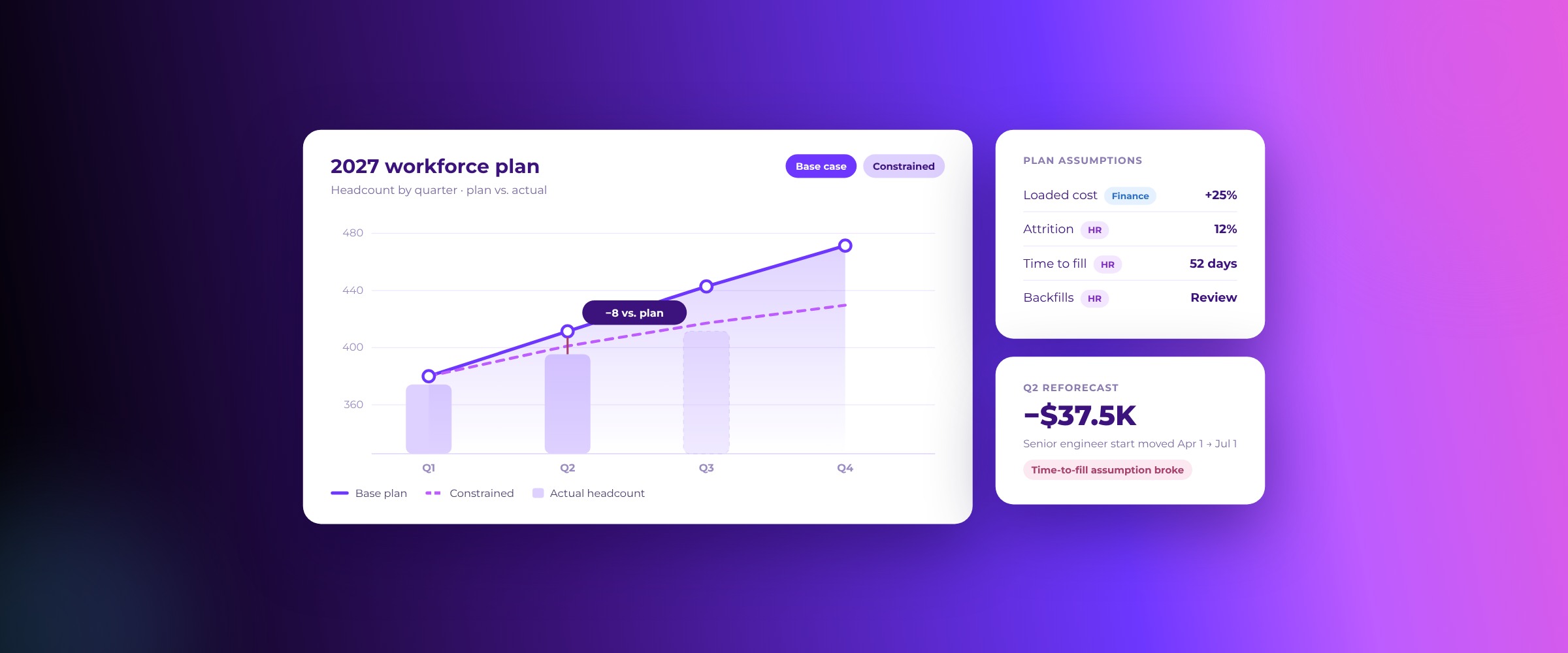
Sometime in the next six weeks, most companies will approve a 2027 headcount budget. Far fewer will have a workforce plan. The two get used interchangeably, and the difference only becomes obvious around March, when the first quarter's hires are running late, two teams have lost people nobody planned to backfill, and Finance and HR are each holding a spreadsheet that claims to be the plan and doesn't match the other one.
The research suggests this is the norm rather than the exception. McKinsey's HR Monitor 2025 found that 73% of organizations do operational workforce planning, but only 12% do long-term strategic workforce planning. In Gartner's 2024 survey of HR leaders, 66% said their workforce planning was limited to headcount planning. Most of us, in other words, are budgeting seats and calling it strategy.
That isn't a moral failing. Headcount budgeting is necessary, it is due on a deadline, and it is the part the CFO will ask about. But it answers a narrower question ("how many people can we afford?") than the one the business actually needs answered ("what work has to get done next year, who will do it, and what happens when our assumptions turn out to be wrong?"). This guide walks through how to get from the first question to the second, from the annual plan through the quarterly reforecast, with a particular focus on how HR and Finance can work from one plan instead of two.
A headcount budget is a cost envelope: a number of positions, a fully loaded cost for each, and a total that fits inside the company's operating plan. A workforce plan includes that envelope, but it also records the reasoning behind it. Why does this team need four engineers rather than two? What did we assume about attrition, about start dates, about how long it takes to fill a senior role? Which roles are must-haves and which are contingent on revenue landing? What would we cut first?
The practical test is simple. If a leader asks in May why their approved hire was paused, can someone answer with something other than "the budget changed"? A workforce plan makes the assumptions explicit enough that when reality diverges (and it will), you can see which assumption broke and decide what to do about it, rather than renegotiating every number from scratch.
The most common starting point is last year's org chart plus or minus a percentage. It is fast and defensible, and it quietly assumes that next year's work looks like this year's. For some teams that is true. For others, particularly where the business strategy is shifting, it bakes in a structure that no longer fits.
A better starting point is a short set of questions for each business leader, asked before anyone talks about headcount:
The last question is the one leaders tend to resist, and it is the most useful. It forces a prioritization that otherwise happens later, under pressure, and usually by whoever happens to be in the room when the budget gets cut.
Most of the friction between HR and Finance in planning season isn't about values. It's about decision rights that were never written down. Finance builds a model from budget targets; HR builds a hiring plan from business-unit requests; the two are reconciled by hand, late, and with a fair amount of mutual suspicion. One way to break that pattern is to agree in advance on who owns which inputs.
A division that works for many companies looks something like this:
The exact split will vary. What matters is that it's explicit, because an unwritten decision-rights model doesn't stay neutral. It defaults to whoever controls the file.
There are three broad ways to build the annual plan, and the right one depends on company stage, how predictable revenue is, and how much you trust managers' requests to reflect real priorities.
Top-down. Leadership sets a total budget (often as a percentage of revenue or a target headcount growth rate) and allocates it by department. Choose this if the company is in a cost-control period or needs a fast answer. Trade-off: it's efficient, but it says very little about which roles matter. Watch out for departments treating their allocation as an entitlement and filling it whether or not the work requires it.
Bottom-up. Each team builds its request from the work it expects to do, and the requests roll up into a total. Choose this if leaders are close to the work and the company can afford to accommodate most reasonable requests. Trade-off: it surfaces real needs, but the total almost always exceeds what the business can fund. Watch out for padded requests, since leaders who expect to be cut learn to ask for more.
Hybrid. Finance sets a provisional envelope, teams build bottom-up plans with priorities ranked, and the executive team reconciles the two. Choose this if you have the time and the cross-functional relationships to run a real negotiation. Trade-off: it produces the best-reasoned plan, and it takes the longest. Watch out for the reconciliation step turning into a closed-door exercise that leaders never see the reasoning behind.
Whichever approach you choose, the plan itself is built from the same pieces.
Start with an honest baseline. That means current headcount, open requisitions, approved but unfilled backfills, contractors and contingent workers, and anyone with a known departure date. Contractors are the piece most often missing. They frequently sit in a different budget line, which makes it easy to under-count the actual cost of getting the work done.
Write down your assumptions. Expected attrition rate (by team, if it varies meaningfully), the merit and promotion budget, expected time-to-fill, and how backfills will be handled. These are the numbers you'll be checking against every quarter, so they need to live somewhere other than a single analyst's head.
Plan at the position level, with start dates. This is where many plans go wrong, because timing changes cost more than people expect. Take an illustrative role with a $120,000 base salary and a 25% load for benefits and taxes, for a fully loaded annual cost of $150,000. If that person starts April 1, the 2027 cost is about $112,500. If they start October 1, it's about $37,500. Either way, the run rate going into 2028 is $150,000. A plan that back-loads hiring can look affordable this year and create a problem next year, and a plan that assumes every role starts in January will almost always show a large underspend that nobody planned for.
Build at least two scenarios. A base case and a constrained case are the minimum. For each role in the plan, decide in advance which scenario it belongs to. This is the work that pays off mid-year: if revenue comes in below plan, you already know which hires pause, and leaders already know where they stand.
Backfill policy deserves its own decision, because it has an outsized effect on both cost and morale. Some companies treat every backfill as automatically approved. Others require each departure to be re-justified as if it were a new role.
Automatic backfills are kind to managers and teams, and they keep the plan stable. They also lock in the current structure, which means a role that made sense two years ago gets refilled without anyone asking whether it still does. Requiring re-approval creates a natural checkpoint for that question, at the cost of slower hiring and a team that is short-staffed while the decision gets made. A middle path is to auto-approve backfills below a certain level or in roles tied directly to revenue or customers, and review the rest. Whatever you choose, decide it before the year starts, not after the first resignation.
The annual plan is a set of predictions, and most of them will be wrong in some way. The quarterly reforecast is where the plan either becomes useful or gets quietly abandoned. A workable reforecast covers four things:
The reforecast is also the moment where a shared system matters most. If HR's headcount numbers and Finance's cost numbers come from different sources, a large part of every quarterly meeting is spent reconciling them, and very little is spent deciding anything.
Many 2027 plans will include some assumption about AI changing how much work a team can absorb. That assumption is worth treating like any other in the plan: written down, specific to a team or type of work, and checked at each reforecast. SHRM's summary of current workforce planning research makes a similar point, that plans should model AI's effect on output realistically rather than assuming immediate gains. A plan that holds headcount flat because "AI will make up the difference," without saying where or by when, isn't really a plan. It's a hope with a budget attached.
Skills are a related question. McKinsey's data suggests that only a minority of organizations doing long-term workforce planning integrate skills data into it. For most mid-sized companies, the realistic starting point isn't a full skills taxonomy. It's asking, for each role request, whether the capability exists elsewhere in the company and whether an internal move would serve the need as well as an external hire.
No workforce plan survives the year intact. Revenue moves, people leave, priorities change, and some hire that looked essential in December turns out to be less urgent by June. The value of the plan isn't in predicting those things correctly. It's in making the assumptions visible early enough that HR, Finance and the business can argue about them while there's still time to change course, and in giving everyone a shared record to return to when something breaks.
If your 2027 plan currently lives in two spreadsheets that don't agree, that's a reasonable place to start.
ChartHop's Headcount Planning lets HR and Finance build one workforce plan against a live budget, with forecast and variance tracking through each reforecast. Book a demo to see how it works.

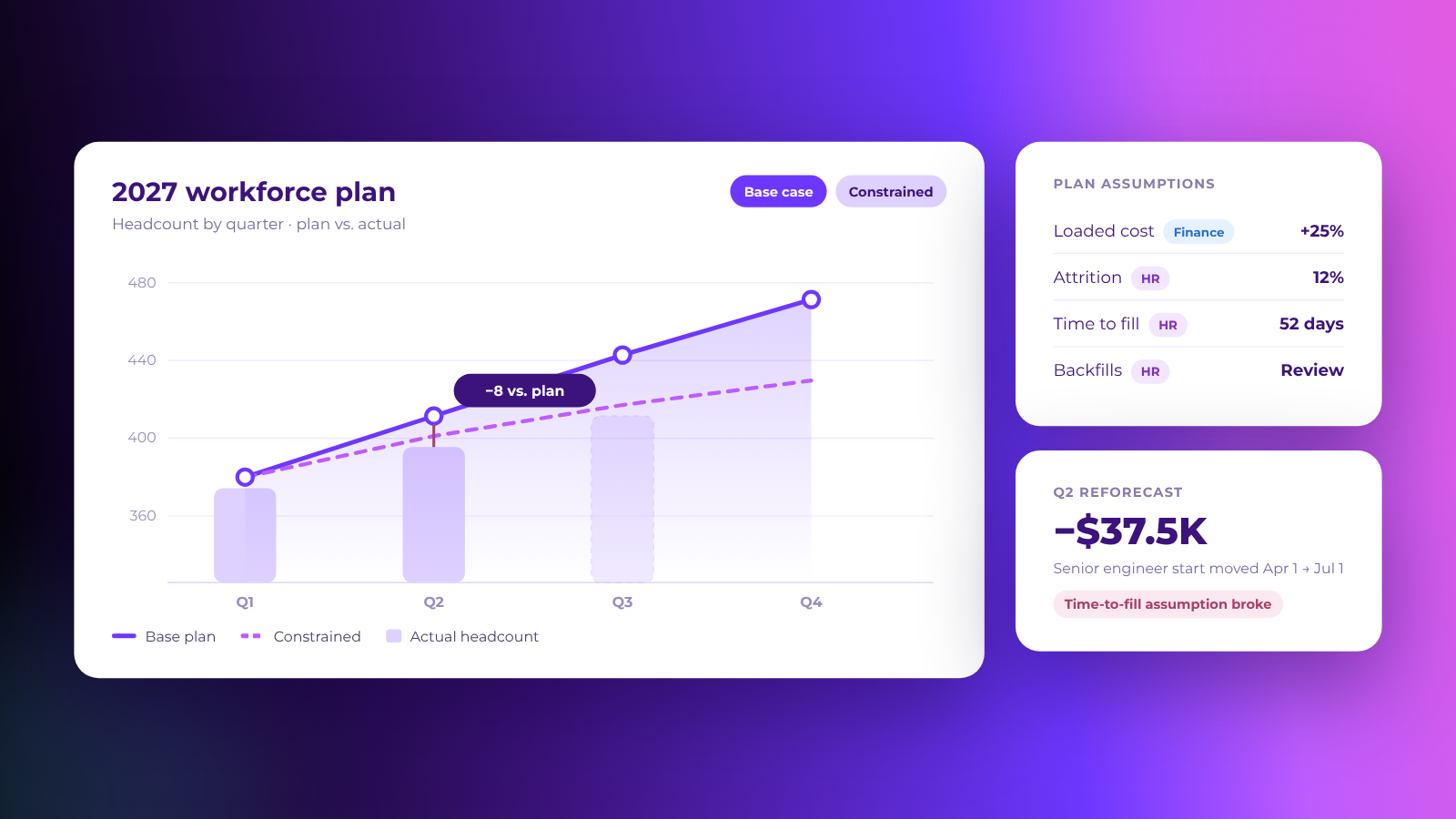

Most companies will approve a 2027 headcount budget. Far fewer will have a workforce plan. A practical guide to building one, from who owns which number to running the quarterly reforecast, so HR and Finance work from one plan instead of two.
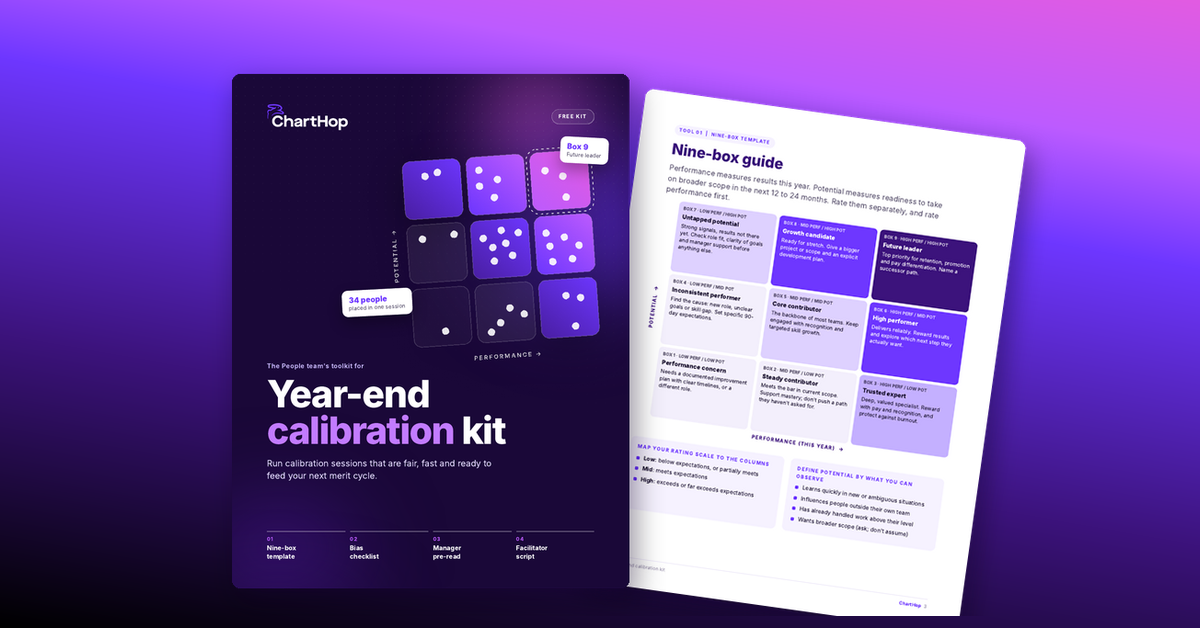
A practical guide to year-end calibration: what the meeting is for, how to prepare managers, a 90-minute agenda and the biases to watch for. Includes a free kit with a nine-box template, bias checklist, manager pre-read and facilitator script.
What stuck with me from Gartner HR Symposium in Orlando: where AI's saved time really goes, why judgment matters as much as governance, the succession planning gap, and why workforce planning needs a single view HR and Finance both trust.


