
.png)
We just launched ChartHop Goals. Watch the product launch event, see the live demo, and find out why we think the entire category has it wrong.
Your company sets goals every quarter. Someone puts them in a spreadsheet, or a standalone OKR tool, or a Notion doc that gets visited twice and forgotten.
Then the real work starts. Revenue data lives in Salesforce. Project delivery lives in Jira. Hiring progress lives in your ATS. And the goals? They sit in their own little corner, disconnected from all of it.
So when leadership asks "are we on track?" nobody actually knows. They guess. They chase people down in Slack. They spend the first 15 minutes of every meeting squinting at a spreadsheet trying to piece together a status update from five different sources.
This isn't a goal-setting problem. It's a visibility problem. And most goal tools don't solve it because they were built to track goals, not to tell you whether the business is actually on track.
We polled the audience live during our launch event. The results were telling:
40% of the room already pays for a dedicated OKR tool. They still showed up to an event about goal tracking. That should tell you everything.
Here's what we think goals should do: connect to the real data that determines whether you're winning or losing.
ChartHop Goals ties objectives at every level of your org to live business metrics. Revenue targets pull from Salesforce. Support metrics pull from Zendesk. Cloud cost targets pull from your infrastructure dashboards. The system handles the numbers. Your people provide the context: qualitative updates, confidence forecasts, and commentary on what's really going on.
Because ChartHop already knows your org structure, the cascade is automatic. Company goals at the top flow down through departments, teams, and individuals. You don't have to manually wire together who reports to whom. It's already there.
Click through this to see it in action:
Three company goals. Each one breaks into team and individual objectives. Every goal has a progress indicator, a confidence level, and an owner. Expand any goal to see how the work rolls up. This is what your leadership team sees instead of a spreadsheet.
And this isn't a concept. We shipped it internally first. At the start of Q4 2025, every person at ChartHop tied their objectives to three company goals. Metrics updated automatically from our own connected systems. The ELT stopped reviewing numbers at the top of every meeting because that information was already visible to the whole company, in real time.
Q4 was our best quarter ever. Not because of a tool. Because 100% of the company could see how their work connected to the business. Transparent goal communication across the org changed how we operated.
Most AI features in HR software generate text nobody asked for. We built ours to answer questions leaders actually have.
"Which goals are on track and which are struggling?" ChartHop AI reads the goal data across your entire org and gives you a summary in seconds. Not a dashboard you have to interpret. A direct answer.
"How do we rally the team around this at-risk goal?" It looks at your org structure, sees who's available, and gives you a specific plan. Not "consider cross-functional collaboration." Actual names, actual suggestions, actual timelines based on when the goal deadline hits.
"Help Marcus get his goal back on track." It reads the history, understands the context, and builds an action plan for today, this week, and the next 48 hours.
This is AI with full organizational context. It knows your goals, your people, your structure, and your data. That's what makes the answers useful instead of generic.
The worst thing about most goal tools is that they're a destination. You have to go find them. Open a separate app. Click into a dashboard. Nobody does that consistently, and that's why goal updates go stale.
In ChartHop, goals show up where you already are. On employee profiles. On team pages. Inside performance reviews. On the org chart. You set the goal once. It appears everywhere it's relevant. Automatically.
During a performance review, the reviewer sees the employee's goals, progress, and latest updates right in the review form. No copy-pasting from another system. No "let me pull up their goals real quick." It's already there.
"We spend so much less time talking about goals and more time working on them."
Pilar Muner, VP of People, ChartHop
This is the fastest module we've ever shipped. Turn it on, set up your goal types, and go. Start with manual updates if you want. Connect your business data when you're ready. Either way, your team can be tracking goals on the first day.
$3 per employee per month. Add it to any ChartHop plan.

.png)

During 5-Minute Frameworks: AI in HR, we had 6 HR leaders & AI Pros give a simple, but impactful framework for how you can utilize AI in HR. This handout synthesizes those key frameworks for HR leaders driving AI transformation, focusing on practical implementation over theory.
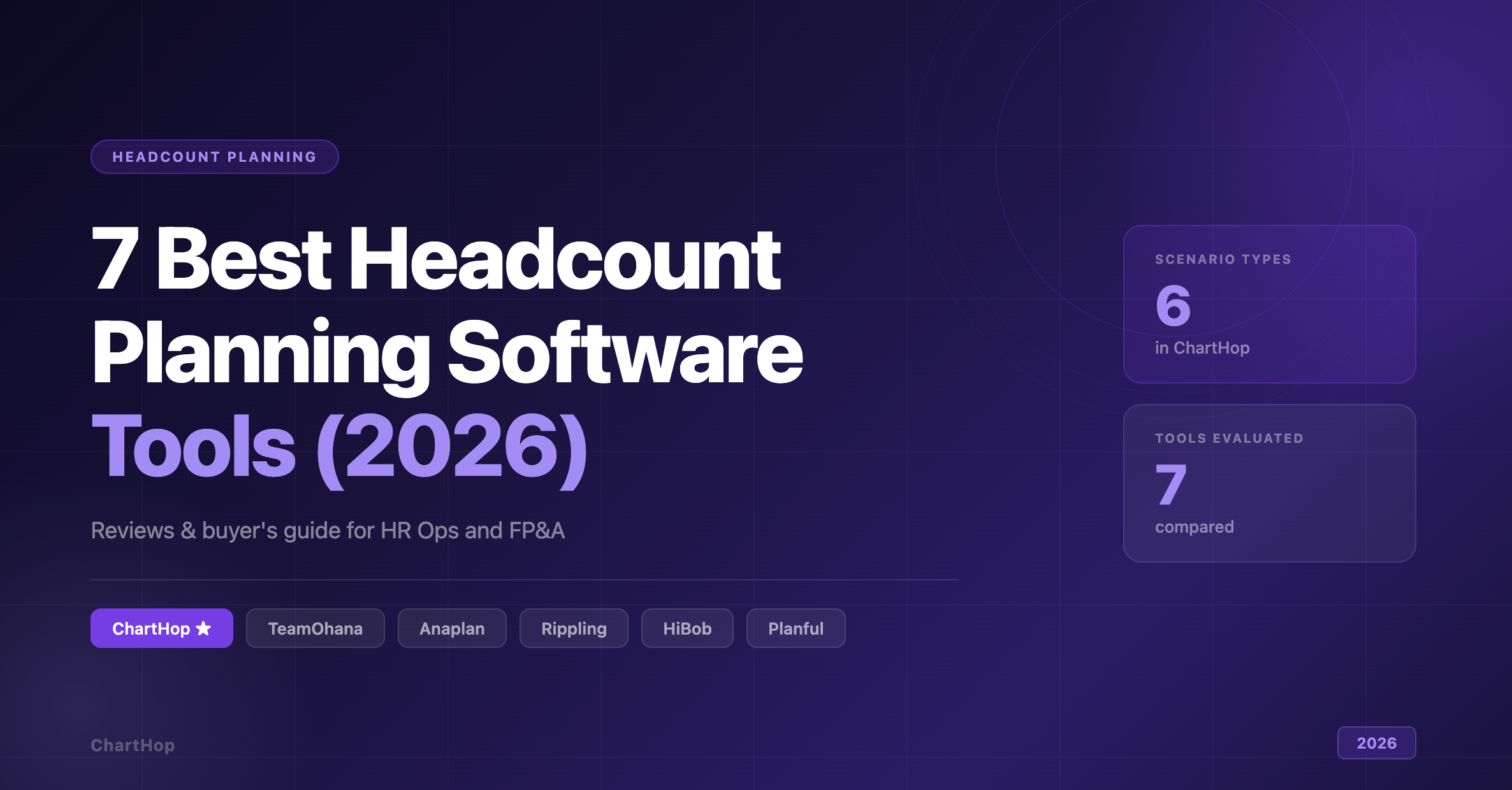
ChartHop leads our evaluation of the 7 best headcount planning software tools in 2026. Compare scenario modeling, approval workflows, integration depth, and budget visibility to find the right fit.
AI agents that do real work, governance that got specific, and why context matters more than data. Our five takeaways from HR Tech 2026 in Las Vegas.

Heading to Gartner HR Symposium/Xpo in Orlando? Our picks for sessions on workforce planning, org design and AI in HR, plus where to find ChartHop at Booth 220.
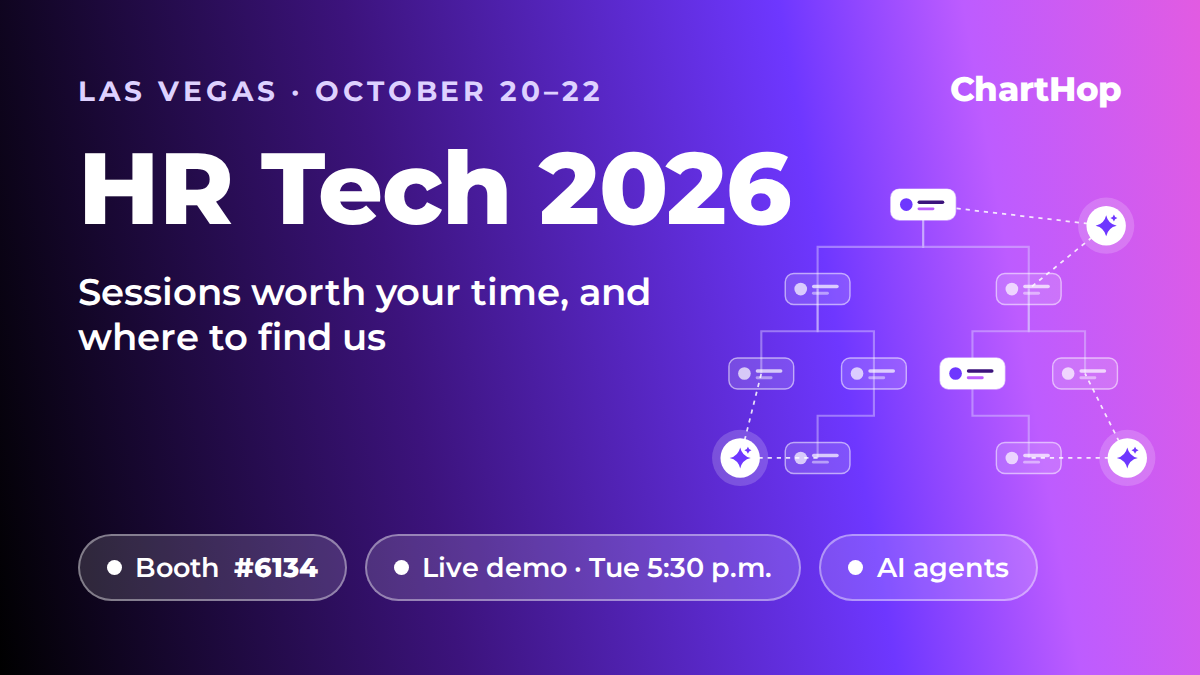
Heading to HR Tech 2026 in Las Vegas? Our take on the show theme, the sessions worth your time, and where to find ChartHop's booth and live demo.