.png)
Seven HR and business leaders. Seven headcount planning frameworks. Five minutes each.
During 5-Minute Frameworks: Headcount Planning, we brought together practitioners to share how they actually approach workforce planning. This guide captures the key takeaways for anyone who attended or missed the live session.
Speaker: Taylor Roa, VP of People at January
The problem: Without strategic context, managers can only tell you how to solve their current pain points. They can't prioritize for where the company is going.
The solution: Give managers directional context before they submit headcount requests, then use async stack-ranking to surface where leaders agree and where they need to hash it out.
Speaker: Emily Stewart, Head of People Ops at OnePay
The problem: HR has one spreadsheet, Finance has another, department heads have a third. You spend more time reconciling data than making decisions.
The shift: When you're not spending hours reconciling spreadsheets, you can focus on what actually matters: being a strategic partner to the business.
Speaker: Tim Gribble, CEO of Cypress.io
The problem: Most companies treat backfills as automatic. Someone leaves, you replace them. But every departure is an opportunity to reassess.
The shift: Move from maintaining headcount to optimizing capacity.
Speaker: Mark Partin, Co-Founder & CEO of B/SPOKE Studios
The problem: Hourly turnover runs higher than salaried roles. You can't plan headcount the same way.
The shift: Design for reality, not perfection. Turnover will happen. Your model should still deliver.
Speaker: Mick Collins, VP GTM at SAP SuccessFactors
The problem: Traditional workforce planning is entirely top-down. Employees aren't part of the process, and engagement suffers.
Passions drive emotional engagement. Emotional engagement drives effort. Effort drives productivity. If you can align what excites people with what creates value for the organization, you get both.
Important caveat: This isn't about letting people work on whatever they want. The work must create value. The question is whether there's overlap.
Speaker: Aisha Stephenson, Fractional HR Leader
The problem: Headcount planning often happens in silos. HR and Finance aren't aligned on how each hire translates to budget.
Start dates aren't logistics. They affect cash flow, ramp speed, and execution. Extending a start date by 30 days can provide breathing room and prevent costly corrections.
You're not an order-taker. You're a steward of timing and cost. Partner early and often with Finance. Use systems to model scenarios instead of reacting to them.
The shift: Headcount planning becomes an engine for growth, not a checkbox exercise.
Speaker: Ian White, CEO of ChartHop
The problem: Spreadsheets store data but limit the dimensions you can work with. Headcount planning has too many variables to juggle manually.
Level 1: Answer questions about your data. Ask in natural language: "How does adding six engineers affect our engineer-to-PM ratio?" Get answers in seconds instead of hours.
Level 2: Surface blind spots. AI spots patterns you miss. Example: A scenario increases average sales team tenure by 18 months because you're not backfilling junior roles. What does that do to ramp time?
Level 3: Pressure test decisions. Ask AI to respond as your CFO, board member, or a specific employee. "What risks would our investors flag about this proposal?"
General tools like ChatGPT don't know your org structure or historical data. Purpose-built AI, like ChartHop, has context, sees your scenarios, and keeps data secure.
The shift: AI isn't replacing judgment. It's a thinking partner that never gets tired and never forgets.
Don't try to implement everything right away. Choose one framework that addresses your biggest gap:
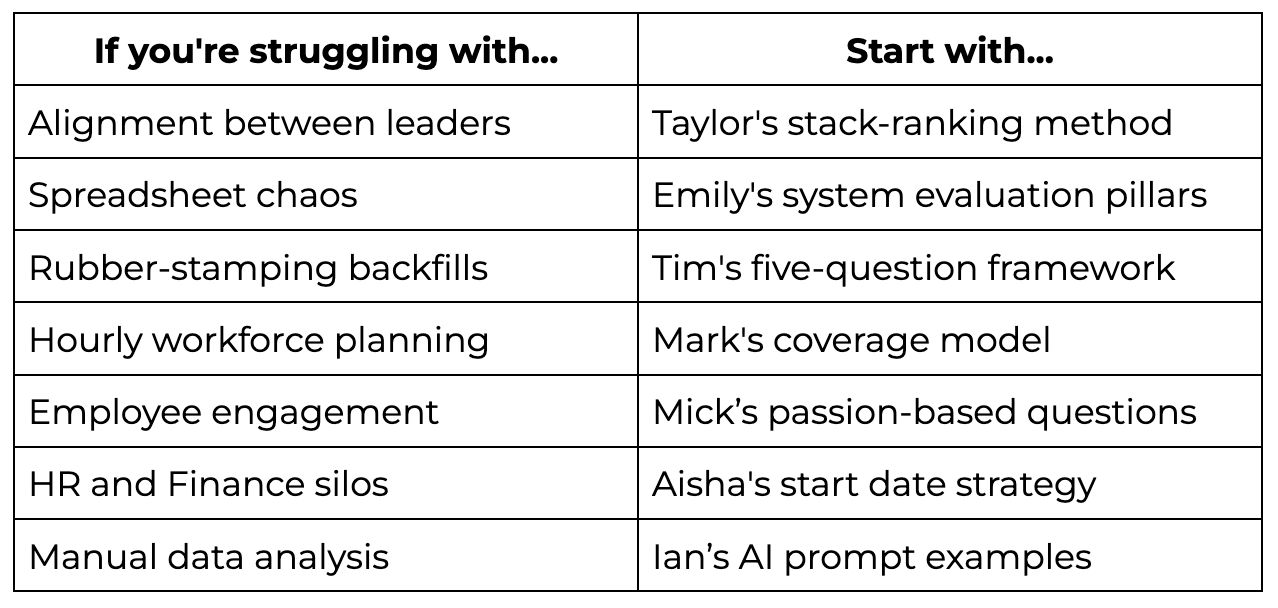
Subscribe to the People Ops Weekly for ongoing frameworks and insights from HR practitioners.
This guide captures the key takeaways from our January 2026 headcount planning session. Start where you are, use what resonates, and keep both your people and business outcomes at the center of every decision.


Use this free library of AI prompts designed for tools like ChatGPT and Ask ChartHop to streamline workflows, improve decision-making, and save time across hiring, onboarding, performance, and vendor evaluation. Built by and for HR leaders.
.png)
During 5-Minute Frameworks: AI in HR, we had 6 HR leaders & AI Pros give a simple, but impactful framework for how you can utilize AI in HR. This handout synthesizes those key frameworks for HR leaders driving AI transformation, focusing on practical implementation over theory.
Organizational intelligence is what a company knows about itself, connected in one place and current enough to decide on. Here is where the term came from, the five layers of data it spans, how it differs from workforce intelligence and people analytics, and the test a system should pass before it uses the name.
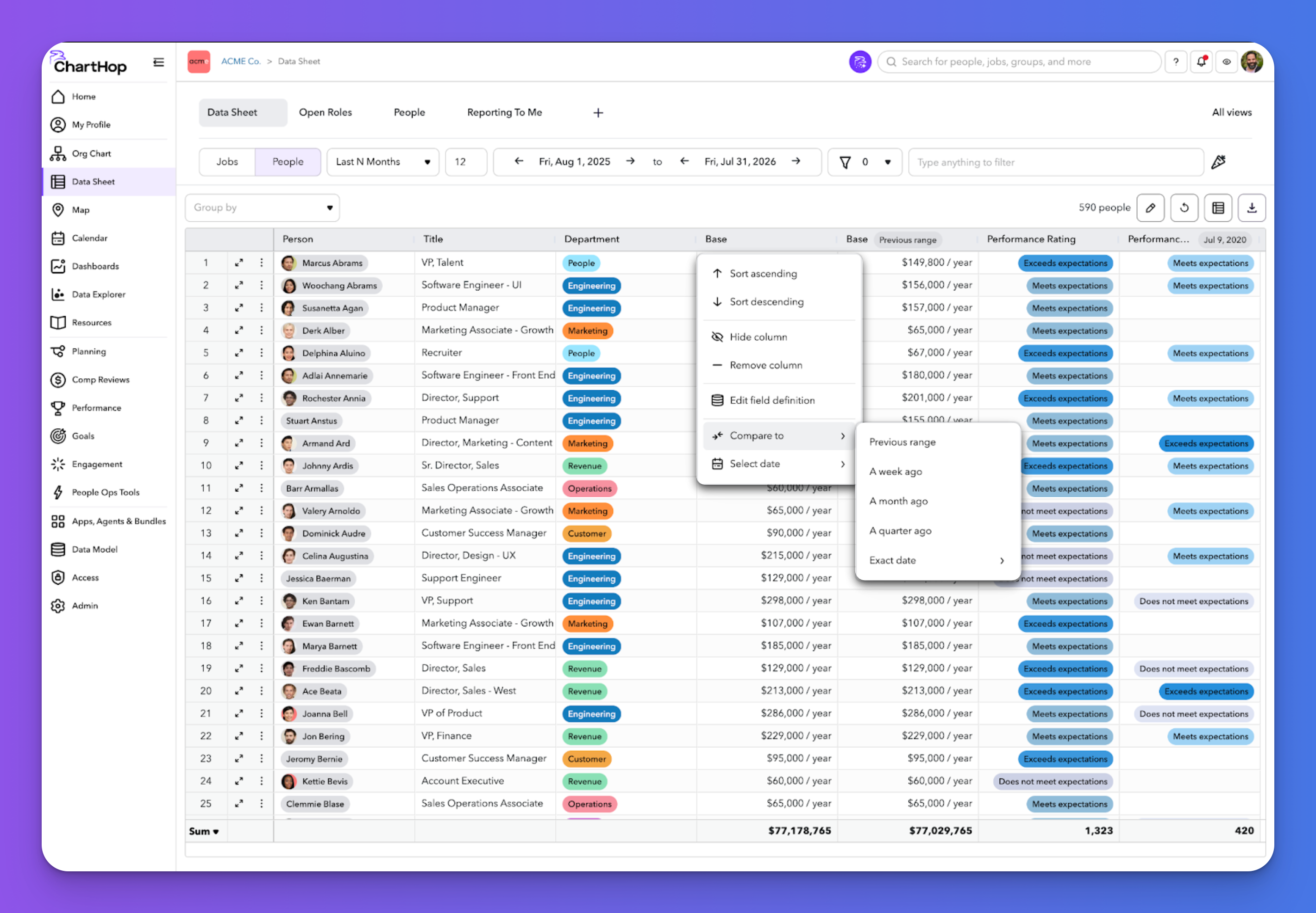
See the latest ChartHop updates for September 2026: time-based columns in the Data Sheet, automated time off milestone awards, fully translated goals, and a smarter scenario org chart.
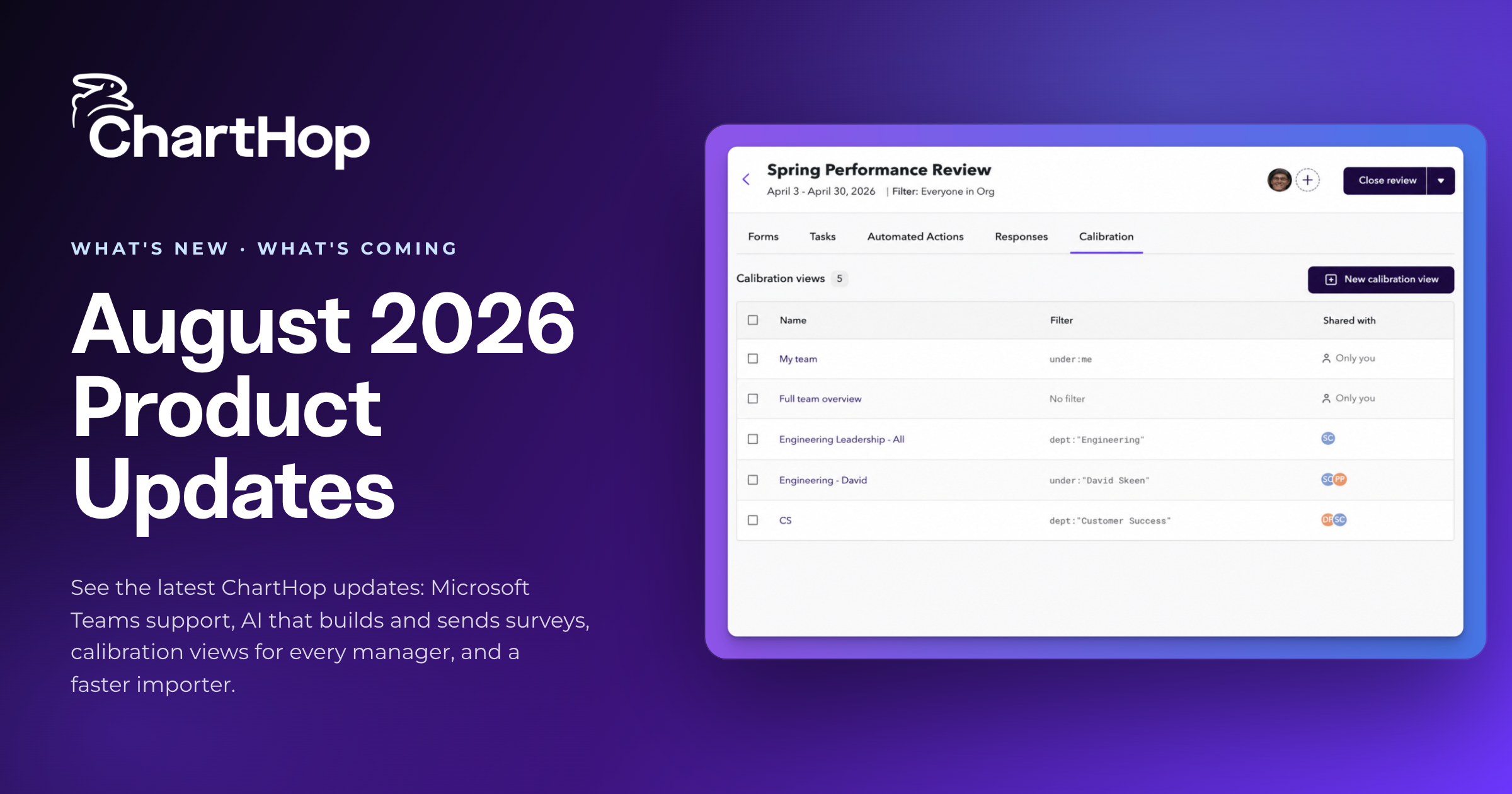
See the latest ChartHop updates for August 2026: Microsoft Teams support, AI that builds and sends surveys, calibration views for every manager, and a faster importer.