
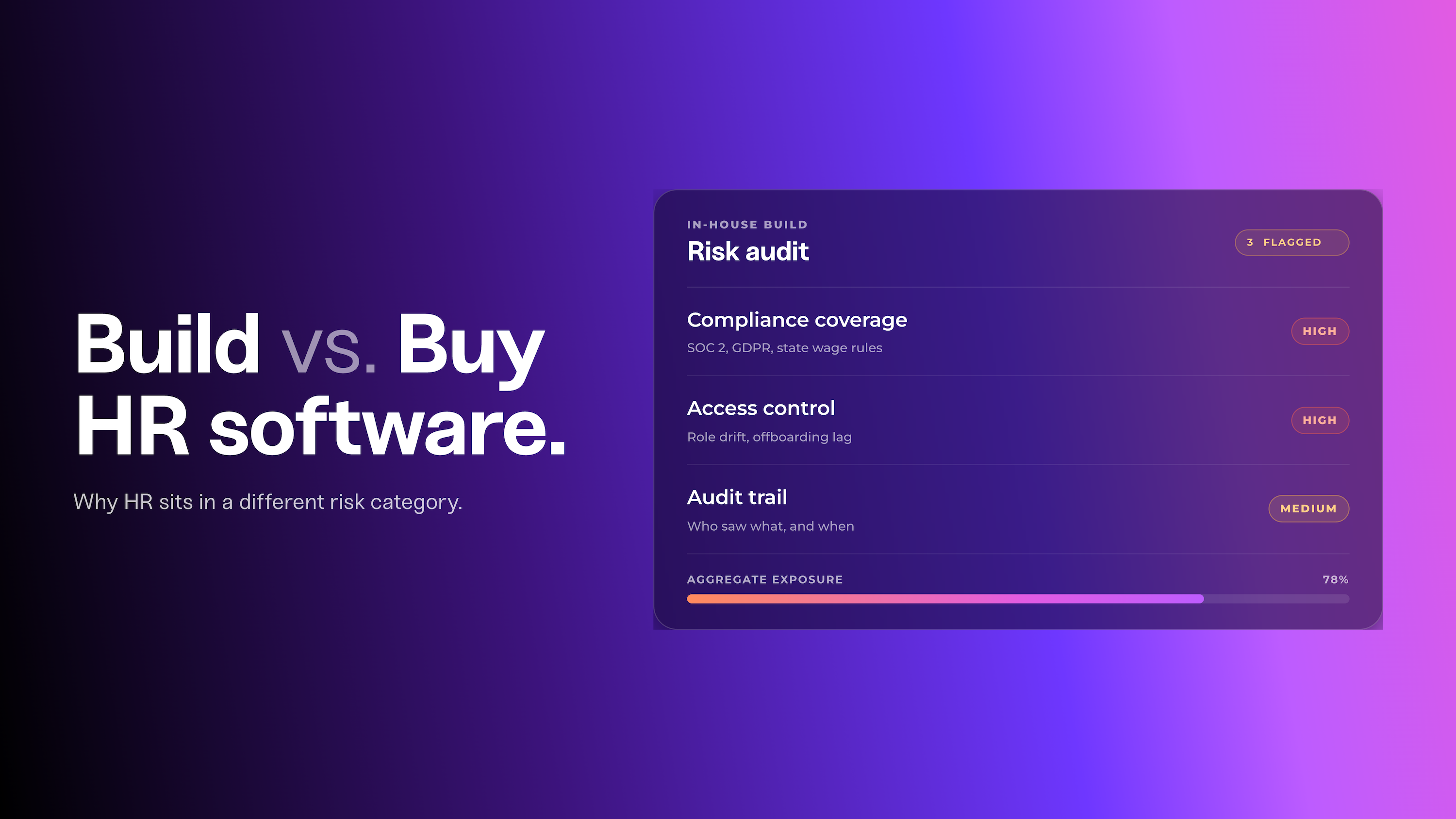
For most teams buying new software, the build vs. buy calculus is straightforward: weigh the cost of engineering time against the cost of a vendor, factor in maintenance, and make a decision. But for HR software, the building software comes with incredibly high risk.
When Engineering teams build internal tooling, the worst-case scenario is usually wasted time, technical debt, or a tool nobody uses. When People teams build internal tooling that touches employee data, the worst-case scenario is a different category entirely: a breach that exposes SSNs, a state attorney general inquiry, a wage act class action, or the slow erosion of trust when employees realize their personal data was visible to half the company.
With AI tools like Claude Code, GitHub Copilot, and Cursor able to spin up a new application in an afternoon, nearly every company is revisiting the build vs. buy debate.
But for HR teams, the debate remains different. AI might be able to easily set up a comp planning workflow, but does it know how quickly you have to send notifications in case of a breach based on each state’s privacy laws? Or what data might be needed for a legal inquiry years down the road? How about how to change access controls after a reorg? All of these matter, and AI isn’t equipped to handle them.
In fact, AI raises the risk. As AI speeds up the development process and makes it accessible to more people, it becomes even easier to forget about the legal risk that HR data carries.
There are six reasons why HR data sits in its own risk category and why that makes the build vs. buy decision for People teams fundamentally different from the same decision in Engineering, Finance, or Product.
HR data is subject to GDPR, CCPA, 20-plus state privacy laws with different definitions of sensitive data, city-level wage transparency laws, EEOC requirements, ERISA for benefits, and HIPAA-adjacent issues for leave and accommodations. An internal build has to either solve all of this or accept the risk. Most internal builds quietly choose the second.
SSNs, dates of birth, home addresses, dependent information, medical accommodation details, compensation data, performance ratings, termination reasons. This isn’t “what features did the user click.” It’s the data that enables identity theft, discrimination claims, and targeted harassment if it leaks. Beyond regulatory exposure, a breach or even a credible threat of one can permanently erode employee trust in ways that are difficult to recover from.
When it comes to this type of sensitive data, access control matters – a lot. Who can see what comp data, who can see whose performance review, who can see the org chart with comp ratios visible are not “set a permission and forget it” problems. They change with every reorg, every promotion, every manager change. Internal builds almost always start with crude permissions and never catch up to the actual complexity.
Every system an internal HR tool needs to connect to (think payroll, HRIS, ATS) carries risk as the data moves. Every integration point is a new place where access controls can break down, data can get out of sync, and audit trails can develop gaps. Vendors build and maintain those integrations as a core part of the product, whereas internal tools typically treat them as an afterthought.
No HR data lives in a vacuum. Comp data feeds performance reviews. Performance reviews feed promotion decisions and termination documentation. Termination documentation feeds litigation defense. A build that's "just" a comp planning tool is actually a system of record for decisions that may need to be defended in court years later. Internal tools rarely think about evidentiary integrity at the outset.
Migrating off a vendor is annoying. Migrating off an internal tool built by one engineer who left two years ago is a six-month project that consumes the entire People team. The time and cost typically exceed anything the original build saved.
None of this means People teams should never build anything. There are real cases where it makes sense, but the criteria are different compared to other functions.
Here’s a framework to use for the build vs. buy decision that takes into account the sensitive nature of HR data:
Build is appropriate when:
Reasonable build candidates include candidate prep guides, internal wikis, benefits FAQ tools, onboarding checklists, manager training portals, culture/values microsites, internal event tooling, and recognition programs without comp implications.
Buy is the right call when:
Before any People team decides to build instead of buy, it’s essential to ask: What are we actually building?
It's easy to think you're building a tool. In reality, when you're building anything that touches comp, performance, or headcount planning, you're building a compliance posture, an audit trail, a security perimeter, and a vendor accountability structure. The tool is maybe 20% of what you actually need.
When you buy from a vendor like ChartHop, you're paying for the other 80%: the SOC 2 certification, the GDPR Data Processing Agreement, the breach notification protocols, the access control infrastructure, and the fact that someone else's legal and security teams have already worked through state-by-state wage transparency requirements so yours don't have to. That accountability doesn't exist when you build internally.
When you account for all of it, building is never actually the cheaper option.



Evaluate AI HR tech vendors with confidence with these 15 critical questions that help you assess how AI is built, governed, and applied in real HR scenarios.

Use this free library of AI prompts designed for tools like ChatGPT and Ask ChartHop to streamline workflows, improve decision-making, and save time across hiring, onboarding, performance, and vendor evaluation. Built by and for HR leaders.
Organizational intelligence is what a company knows about itself, connected in one place and current enough to decide on. Here is where the term came from, the five layers of data it spans, how it differs from workforce intelligence and people analytics, and the test a system should pass before it uses the name.
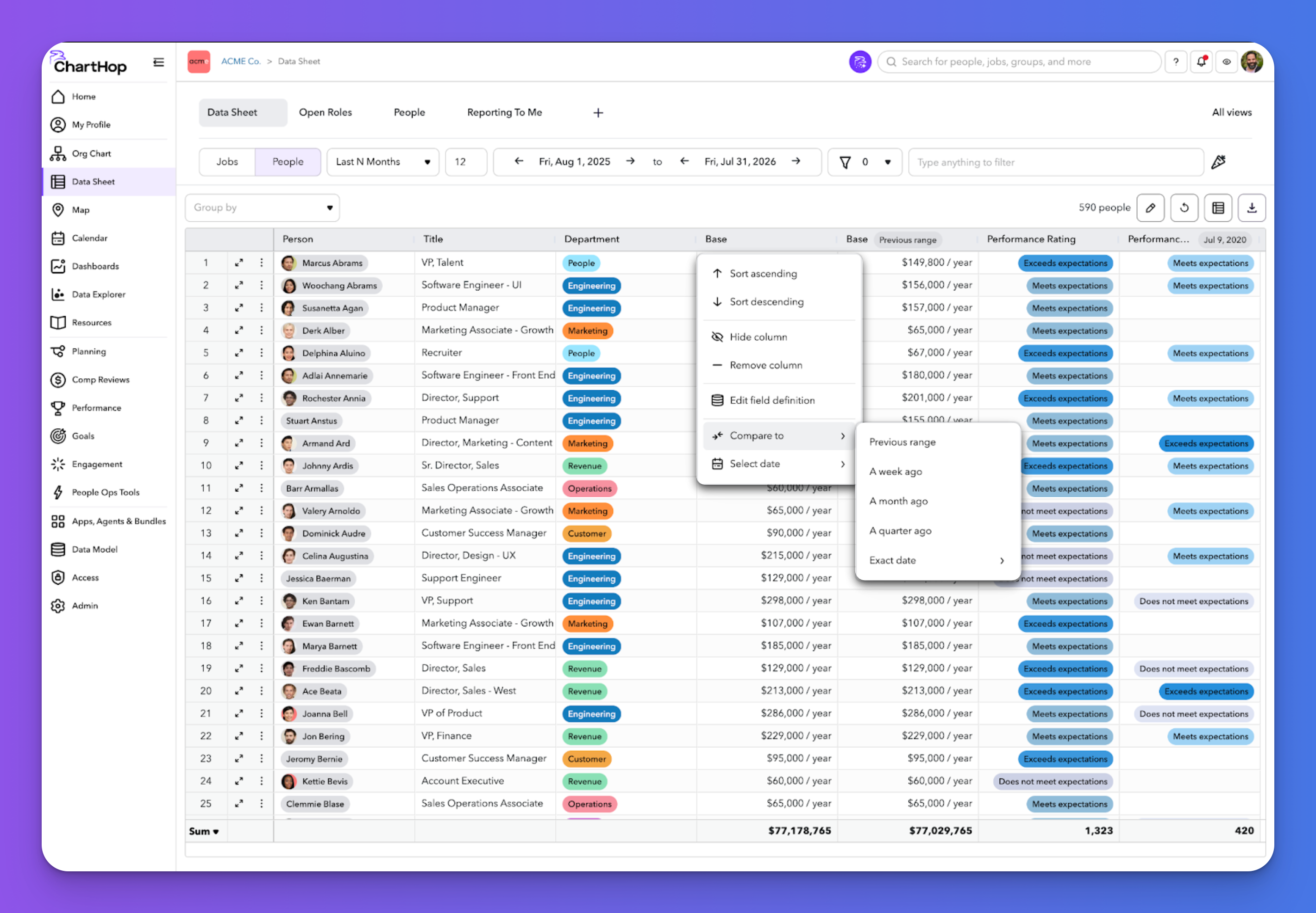
See the latest ChartHop updates for September 2026: time-based columns in the Data Sheet, automated time off milestone awards, fully translated goals, and a smarter scenario org chart.
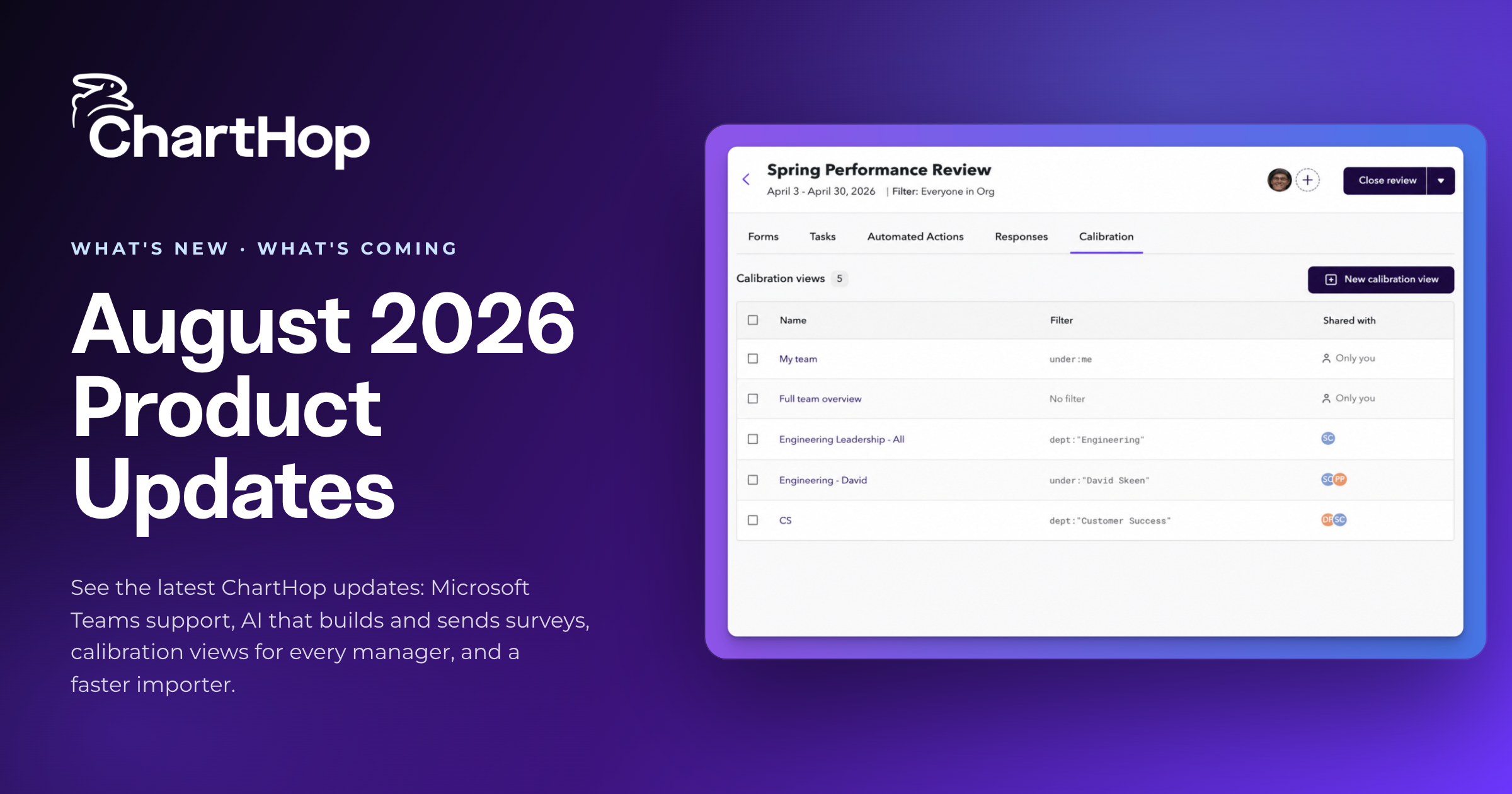
See the latest ChartHop updates for August 2026: Microsoft Teams support, AI that builds and sends surveys, calibration views for every manager, and a faster importer.