You're in the board meeting, and the question sounds simple enough.
"You're planning 12 percent revenue growth next year on 4 percent headcount growth. Walk us through where that comes from."
You know part of the answer. So does everyone else at the table. Sales has ramp times and quota attainment. Finance has what's approved and what it costs. Your people team knows who's actually in seats, who's leaving, and which teams are underwater. Somebody in ops has been quietly tracking which functions picked up the new AI tooling and which ones nodded and carried on as before.
Nobody has all of it in one place.
So you tell them you'll come back to it. Three people spend the next two weeks building a deck, and by the time it lands, two of the assumptions have already moved.
If you've lived that, you already understand the problem. That gap, between the question and the answer, is what organizational intelligence closes.
Organizational intelligence is what a company knows about itself, connected in one place and current enough to decide on.
That's the idea. The software that enables it, an organizational intelligence system, connects your people, work, operations, revenue and business data into a living model of your whole organization, then provides the workflows and agents you need to act on it. It covers how you're structured, what your teams cost, and how you perform. And it builds on the systems you already run instead of replacing them.
Here's the frustrating part. You almost certainly have the data already. It's sitting in your HRIS, your ATS, your CRM, the finance system, the ticketing tool and a few hundred spreadsheets. Ask who pulls all of that into an answer today and the honest response, at most companies, is a consultant and a spreadsheet. Which is accurate for about a week.
Search the term and you'll run straight into a body of management theory that predates all of this by about sixty years.
Harold Wilensky used it as the title of his 1967 book on how governments and companies gather knowledge and then fail to use it. Karl Albrecht turned it into a scoring model in the early 2000s, rating organizations across seven dimensions like strategic vision, shared fate and appetite for change.
That version asks how smart your organization is as a collective. It's a diagnostic, and you measure it with a survey.
The version we're talking about asks, what do you actually run in order to know your own company? And how long does it take you to get a correct answer to a question that crosses more than one department?
The two concepts do meet in one place: you're never going to be intelligent about your organization while the data about it is scattered, stale and re-argued in every meeting.
Go back to that board question for a second. Answering it properly means touching five different kinds of data, and most software covers just one or two of them.
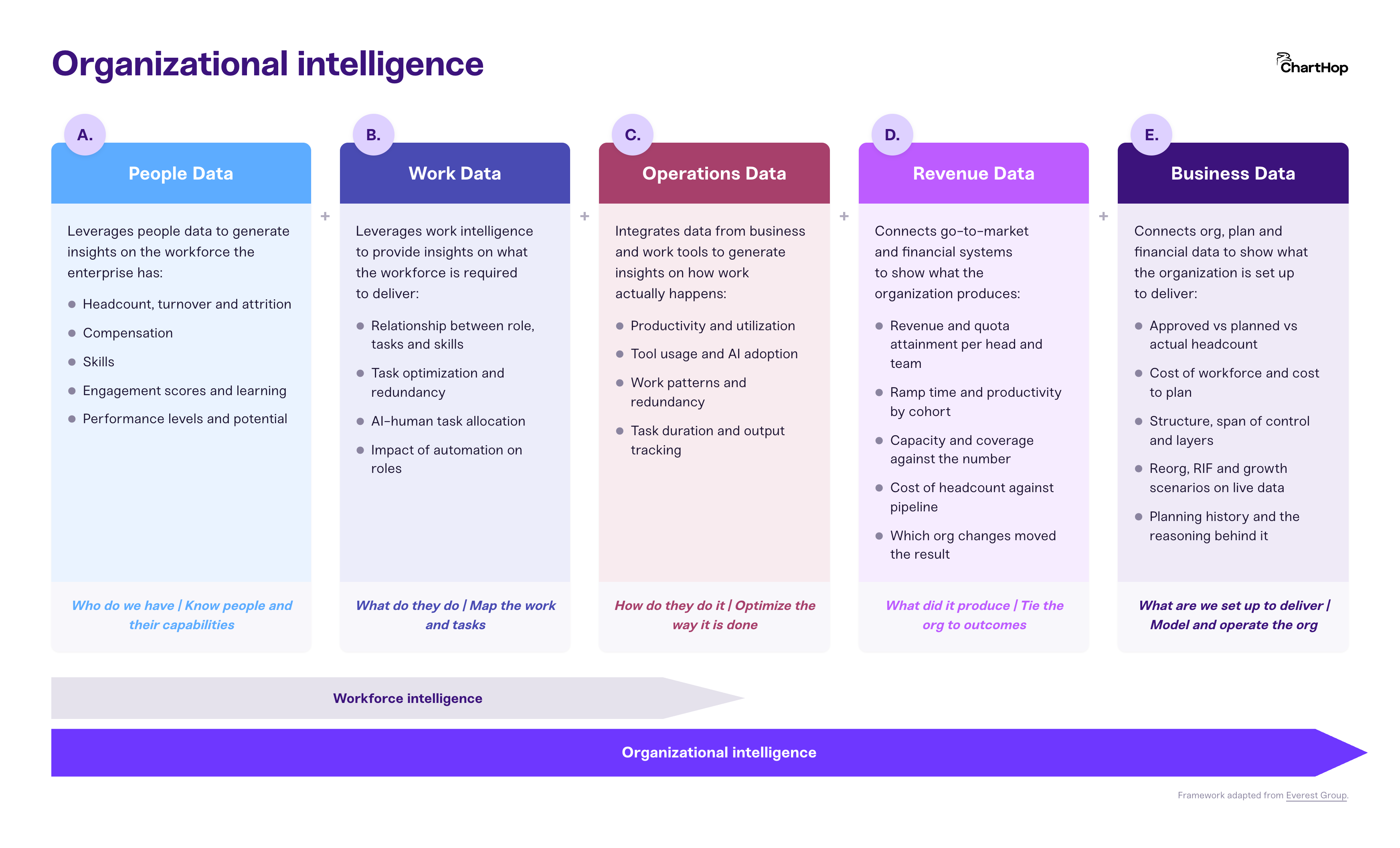
The first three layers were set out by Everest Group in January 2026, framing workforce intelligence around three pillars, people, work and execution, with three questions underneath: who do we have, what do they do, how do they do it. Organizational intelligence builds on these:
1. People data. Who do you have? The stuff you'd expect. Headcount, turnover and attrition, compensation, skills, engagement and learning, performance and potential.
2. Work data. What do they do? How roles, tasks and skills relate to each other. Where work is duplicated. How tasks get split between your people and AI agents. And which roles automation actually changes, as opposed to which ones a vendor says it will.
3. Operations data. How do they do it? Productivity and utilization, tool usage and AI adoption, work patterns, task duration and output. This one comes out of the business tools where the work happens, not out of an HR system.
4. Revenue data. What did it produce? Revenue and quota attainment per head and per team. Ramp time by cohort. Capacity and coverage against the number. Cost of headcount against pipeline. And which org changes moved the result, versus which ones just moved boxes.
5. Business data. What are you set up to deliver? Approved versus planned versus actual headcount. Cost of workforce and cost to plan. Structure, span of control, layers. Reorg, RIF and growth scenarios modeled on live data. Plus your planning history, including the reasoning behind decisions everyone has since forgotten making.
It's not uncommon for the following four terms to be used as if they're interchangeable. But they're not, and the difference matters when you're deciding what to put to work for your organization.
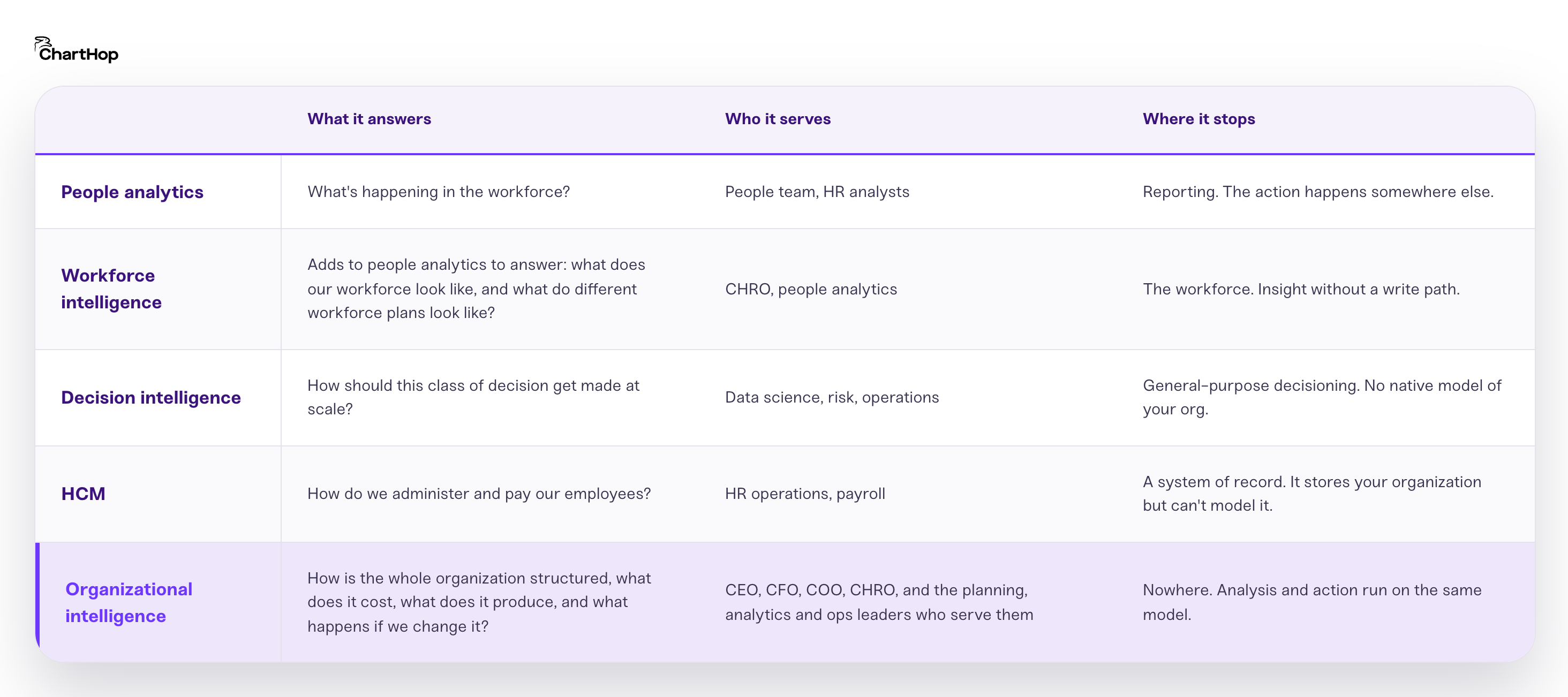
People analytics. Answers what's happening in the workforce. Built for the people team and HR analysts. Stops at reporting, because the action happens somewhere else.
Workforce intelligence. Adds to people analytics to answer what your workforce looks like and what different workforce plans look like. Built for the CHRO and people analytics. Stops at the workforce, and gives you insight without a write path.
Decision intelligence. Answers how a whole class of decision should get made at scale. Built for data science, risk and operations. Stops at general-purpose decisioning, with no native model of your org.
HCM. Answers how you administer and pay your employees. Built for HR operations and payroll. It's a system of record: it stores your organization but can't model it.
Organizational intelligence. Answers how the whole organization is structured, what it costs, what it produces, and what happens if you change it. Built for the CEO, CFO, COO and CHRO, along with the planning, analytics and ops leaders who serve them. It doesn't stop anywhere, because analysis and action run on the same model.
Two of those are worth a bit more.
Workforce intelligence is the nearest neighbor. The difference comes down to scope and the write path. Workforce intelligence tells you about your people. Organizational intelligence tells you about your company, your people included, and lets you act inside the same system.
Put plainly: workforce intelligence gets your CHRO better answers. Organizational intelligence gets your CHRO, your CFO and your COO the same answer, which turns out to matter more.
HCM is the system of record underneath all of it, and organizational intelligence doesn't replace it. It reads from it, along with everything else.
Worth holding onto that one, because here's where it bites. If a system needs you to adopt its HCM before it can be intelligent about your organization, you've quietly bought a suite. Being able to connect whatever you already run is most of the value here.
The category is forming, the term is appealing, and a lot of tools are about to reach for it. So here's a test you can run yourself. Real organizational intelligence does all seven of these.
1. It covers your whole organization, not just your workforce. People, business and financial data on one model. How you're structured, what you cost, what you produce.
2. It builds from the systems you already run. It sits above your ERP, CRM, HRIS and BI systems rather than replacing them. No rip-and-replace, and no new silo for someone to maintain. If a vendor requires you to use their HRIS or HCM to get it to work, it is not an organizational intelligence system.
3. It's live, and it remembers. Current by default through continuous syncs, not quarterly extracts. And it keeps the history of how your organization changed and why, so you can go back to any date and see what was true then. Most companies can tell you what their org looks like today. Very few can show you what it looked like the day they approved the plan.
4. It models what happens next. Scenario branching on live data, with approved reality kept separate from hypothetical futures. You get to watch the org change before it does.
5. It's governed, so it can be open. One of your managers should be able to pull their own answer without seeing anyone's compensation or performance data. Governance is what makes that safe, and safe self-service is what makes the whole thing useful to more than four analysts.
6. It takes actions, not just measurements. Run the review, set the goals, build the comp plan, make the org change, open the req. On the same model the analysis came from. A system that only reports is a dashboard, and you already have plenty of those.
7. Its AI acts inside those workflows. Agents that reason over an accurate model of your organization and then execute in it. Draft the comp cycle, flag the span-of-control break, model the reorg. An assistant that can describe your org chart but can't change anything is a search box with better manners.
Your workforce is the biggest line item and the least instrumented. People costs run 60 to 70 percent of operating spend at most companies. Finance instrumented revenue twenty years ago and spend ten years ago. Meanwhile your organization is still described in a slide deck that was accurate the morning someone made it.
AI turned context into the bottleneck. You're being asked whether a given task is better done by a person or an agent, and what the return on all that AI spend actually is. Neither question survives contact with reality unless you know what the work is, who does it, what it costs and what it produces. Which is to say, the five layers above. AI is only as good as its model of your organization, and most companies have never built one.
Agents need a write path and a permission model. The moment AI moves from answering questions to taking actions, the question stops being "what does the data say" and becomes "what is this agent allowed to change, and against which version of the truth." That needs a governed, current model of your organization. A chat window bolted onto a reporting tool isn't going to get you there.
Next time someone tells you they do organizational intelligence, try these.
Since you've read this far, here's our answer to our own test.
ChartHop is the organizational intelligence company. The platform connects your people and business data from any source into a living model of your whole organization, with the HCM and headcount planning workflows your people team relies on today, and analytics and agentic AI running through all of it.
Your HRIS, ATS, CRM and finance systems stay exactly where they are. Keep the system of record you have, or use ours.
Any system. Every decision.
A few things that come up a lot.
Organizational intelligence is a company's ability to see how it's structured, what it costs and what it produces, connected in one live model, and to act on that picture. As a software category, an organizational intelligence system connects people, work, operations, revenue and business data from the systems a company already runs, then carries the workflows and AI agents needed to act on it.
Scope and action. Workforce intelligence covers the people in your organization and produces insight; the action usually happens in another system. Organizational intelligence covers your whole organization, including how it's structured, what it costs and what it produces, and lets you execute the decision on the same model the analysis came from.
No. People analytics is a discipline and a reporting capability focused on your workforce. Organizational intelligence is the connected model underneath it, spanning people, work, operations, revenue and business data, with the workflows to act on what the analysis shows. People analytics is one of the things an organizational intelligence system does.
No. An organizational intelligence system reads from your HRIS along with your ATS, CRM, finance and operational systems. Some vendors also sell an HRIS, but requiring their own system of record is a limitation rather than a feature. Being able to connect whatever you already run is what makes the model complete.
The people who decide how an organization is structured, staffed and funded. That means the CEO, CFO, COO and CHRO, along with the people operations, people analytics and workforce planning leaders who serve them. It's a broader buying group than people analytics, which usually sits inside the HR org.
An organizational intelligence system is the software that makes organizational intelligence operational. It connects data from the systems you already run into a live model of your organization, preserves the history of how that organization changed, models scenarios before you commit to them, governs who can see what, and carries the workflows and agents to act inside it.
The older sense, from Harold Wilensky and later Karl Albrecht, describes how intelligent an organization is as a collective, and it's measured by assessment. The current sense describes the infrastructure a company runs to know itself, and it's measured by whether a leader can get a correct cross-functional answer quickly. The older idea is a diagnostic. The newer one is a system.


Heading to HR Tech 2026 in Las Vegas? Our take on the show theme, the sessions worth your time, and where to find ChartHop's booth and live demo.
Organizational intelligence is what a company knows about itself, connected in one place and current enough to decide on. Here is where the term came from, the five layers of data it spans, how it differs from workforce intelligence and people analytics, and the test a system should pass before it uses the name.