The Headcount Planning Maturity Model: Which Stage Are You In?
Mar 19, 2026
|
Reading time: 10 min
Sharon Rusinowitz
Director of Content Marketing
Most headcount planning processes start the same way: someone opens a spreadsheet, builds a few formulas, and emails it around. Six weeks later, Finance and HR are working from different numbers, nobody knows which tab is current, and the CFO is asking why the hiring plan doesn't match the budget.
Sound familiar? Most organizations go through the same progression — and knowing exactly where yours sits is the first step to moving forward. The headcount planning maturity model is a five-stage framework that maps how organizations evolve from reactive, spreadsheet-dependent planning to fully connected workforce strategy.
Key Takeaways
Five distinct stages define the evolution from ad hoc spreadsheets to predictive, connected workforce strategy.
Most organizations stall at Stage 2 or early Stage 3 — getting unstuck requires both HRIS integration and cross-functional agreement on shared definitions, happening in parallel.
Scenario modeling at Stage 4 replaces gut-feel decisions with side-by-side comparisons of cost, timeline, and capacity impact — before anyone commits budget.
Companies like Wistia and YipitData each save 8–10 hours per week after reaching connected planning at Stage 5. Those hours come back as analysis time, not administrative time.
AI is compressing the maturity curve. Planning cycles that took weeks now take hours.
What Is the Headcount Planning Maturity Model?
The headcount planning maturity model is a five-stage framework describing how organizations evolve from reactive, spreadsheet-based workforce planning to fully integrated, predictive systems — with each stage representing a measurable improvement in data reliability, process standardization, and cross-functional alignment between HR, Finance, and business operations.
Knowing your stage tells you what's actually broken and where to invest next.
The 5 Stages of Headcount Planning Maturity
Stage 1: Reactive / Ad Hoc Planning
Planning happens when someone asks for it. Hiring decisions are crisis-driven, data lives in personal spreadsheets, and there's no recurring process. Success depends entirely on individual heroics — not systems.
Where to start — Stage 1You need a process before you need a platform. Establish a quarterly planning cycle, designate a single owner for the master headcount file, and get HR and Finance aligned on shared definitions for "headcount," "FTE," and "fully loaded cost." If you're starting from scratch, our headcount planning checklist walks you through the first five steps.
Stage 2: Repeatable Planning
Basic templates and a recurring cycle emerge. Both HR and Finance know a process exists, but manual reconciliation persists and data still travels by email. The cost compounds with every org change. As Taylor Roa, Director of Talent and Culture at Wistia, put it: "The manual changes to a headcount plan for Finance and budget purposes actually takes way more time than you will ever imagine. If you think about every promotion, every raise, every hire, and every departure for a company that's over 200 employees, that becomes a huge time suck to manually keep track of." Most mid-market companies get stuck here longer than they expect.
Where to start — Stage 2The emailed spreadsheet has to go. Prioritize HRIS integration — even a read-only data sync gets you further than you'd expect — and schedule your first joint HR-Finance reconciliation meeting. Before you buy, review our guide to HRIS integration considerations.
Stage 3: Defined Planning
Processes are documented and standardized. HRIS adoption creates a single source of truth, shared definitions reduce ambiguity, and workflows have named owners. This is the first stage where Finance can trust the numbers without a forensic audit.
One honest note: the Stage 2-to-3 transition is harder than it looks. It requires a technical investment (HRIS integration) and a human one (cross-functional alignment on definitions and process ownership) happening in parallel — and most organizations underestimate the second one.
Where to start — Stage 3Build on the foundation. Introduce scenario modeling, set up your first real-time dashboard, and formalize the HR-Finance planning cadence with a shared calendar and clear decision rights.
Stage 4: Managed Planning
Real-time dashboards replace monthly reporting cycles, scenario modeling enters the toolkit, and HR-Finance collaboration shifts from ad hoc reconciliation to a formal protocol. Decisions start being driven by data rather than instinct. Finance stops reacting to HR's hiring plan and starts co-owning it.
Where to start — Stage 4Connect your workforce plan to revenue and capacity models and start reducing planning cycle time deliberately. This is where AI pays off fastest. A CFO can ask ChartHop in plain language — "What's our headcount variance by department against budget this quarter?" — and get an immediate answer instead of waiting two days. ChartHop AI applies the same capability to AI-powered scenario planning: describe a proposed org change and get a draft scenario with budget impact in minutes.
Stage 5: Optimized / Connected Planning
Changes in the hiring plan automatically update budget forecasts. Planning cycles compress from weeks to days. Workforce decisions directly support revenue targets — not just headcount.
YipitData reached this stage and describes the shift plainly. Jaime Moskowitz, Senior People Operations Associate: "FP&A has the ability to work directly with senior leadership and managers in a shared platform, where everyone can see all current employee information. Combining forces together when it comes to headcount planning to see everything as one larger picture has been great." The result: 10 hours saved per week.
Stage 5 Integration Map
Stage 5 planning often fails for a mundane reason: the strategy is sound, but system handoffs are still manual. This map makes those handoffs visible.
Where to start — Stage 5Look at planning cycle time, variance drivers, and manual system handoffs — then systematically eliminate what remains. Extend connected planning to contingent workforce, skills planning, and internal mobility. The advantage at Stage 5 isn't better data. It's acting on it faster than anyone else.
🎯
2-Minute Assessment
Not sure which stage you're in?
Take our interactive quiz and get a personalized roadmap — including the exact next steps and tailored resource recommendations for your stage.
Efficiency. Wistia saves 8–10 hours per week. YipitData saves 10 hours per week. Time that was previously lost to reconciliation gets redirected toward the analysis and strategy work that actually moves the business forward.
YipitData — redirected from reconciliation to analysis
Forecast accuracy. When HR and Finance measure against the same baseline, planned-versus-actual variance shrinks. Automated reconciliation catches comp variance before it becomes a budget overage.
Board readiness and M&A defensibility. When the board asks why headcount spend is 12% above plan, a Stage 4–5 organization answers in the meeting. A Stage 2 organization schedules a follow-up. The same gap shows up in M&A due diligence — connected, auditable workforce data is a material advantage.
Future-readiness. Organizations at higher maturity stages replace reactive backfilling with proactive workforce strategy, including internal mobility and reskilling that Stage 1–2 organizations rarely have bandwidth to consider.
Your headcount budget deserves better than a spreadsheet.
See a live view of spend vs. plan — by department, role, and quarter — without waiting on HR to pull a report.
Answer these questions about how your organization actually operates today. Your current stage is the highest level where you can answer yes.
Stage
Diagnostic Question
Stage 1
Does headcount planning happen only when someone asks for it, with no recurring process or owner?
Stage 2
Do you have a recurring planning cycle, but data still travels by email and reconciliation is manual?
Stage 3
Do HR and Finance pull from a shared data source with agreed-upon definitions and documented workflows?
Stage 4
Can you model multiple what-if scenarios and compare budget impact side by side, without a manual refresh?
Stage 5
Do changes in your hiring plan automatically update budget forecasts, capacity models, and revenue planning?
The Bottom Line
Headcount is almost always the largest line item on a company's P&L — and in most organizations, it's still being managed with tools that weren't built for the job. The maturity model isn't about chasing a perfect process. It's about identifying the one thing that's creating the most friction in your current planning cycle and fixing that first. Better definitions, a shared data source, a first real scenario — each step compounds. Organizations that invest in planning infrastructure don't just save time. They make better decisions, faster, with fewer surprises at the board level.
Common questions about headcount planning maturity stages and how to advance
A five-stage framework describing how organizations progress from ad hoc, spreadsheet-based workforce planning to fully integrated, predictive systems — helping HR and Finance leaders identify gaps and prioritize what to build next.
Most mid-market organizations sit at Stage 2 or early Stage 3: a recurring planning process exists, but it still relies on emailed spreadsheets and manual HR-Finance reconciliation.
They weren't built for collaboration. Spreadsheets work fine for one person in isolation. They break down the moment multiple stakeholders need to work from the same data simultaneously. Formula errors propagate silently, version control becomes a full-time job, and the complexity of managing headcount across departments eventually outpaces what any spreadsheet can handle.
It removes the manual consolidation step where most errors originate. When HR and Finance pull from the same system automatically — rather than exporting files and reconciling by hand — the data is current, consistent, and trustworthy. Reconciliation becomes a verification step rather than a forensic exercise.
Building multiple what-if workforce plans — each with different growth, attrition, and budget assumptions — and comparing their outcomes side by side before committing resources. The goal isn't to predict the future perfectly. It's to understand the trade-offs of each path before you're already on one.
Integration with your existing HRIS and finance systems is non-negotiable. Beyond that, headcount planning software should include scenario modeling, configurable approval workflows, and real-time dashboards. AI-powered features like natural language querying and generative scenario planning are increasingly worth evaluating, particularly for the analyst time they recover at Stage 4.
It's making analysis available to more people, faster. Instead of waiting days for a report, a CFO can ask a plain-language question and get an immediate, data-backed answer. On the planning side, AI-powered scenario planning can generate draft scenarios from a conversational description, turning a multi-day modeling exercise into a starting point ready to pressure-test in an afternoon.
Customer
Share this
Get in touch
Make one good decision that leads to a lot of others. Talk to ChartHop today.
Learn how hybrid headcount planning combines top-down financial discipline with bottom-up operational knowledge — and why real-time scenario modeling and approval workflows make it work.
Take this 2-minute quiz to find out where your headcount planning process stands and get a personalized roadmap to improve accuracy, speed, and HR-Finance alignment.
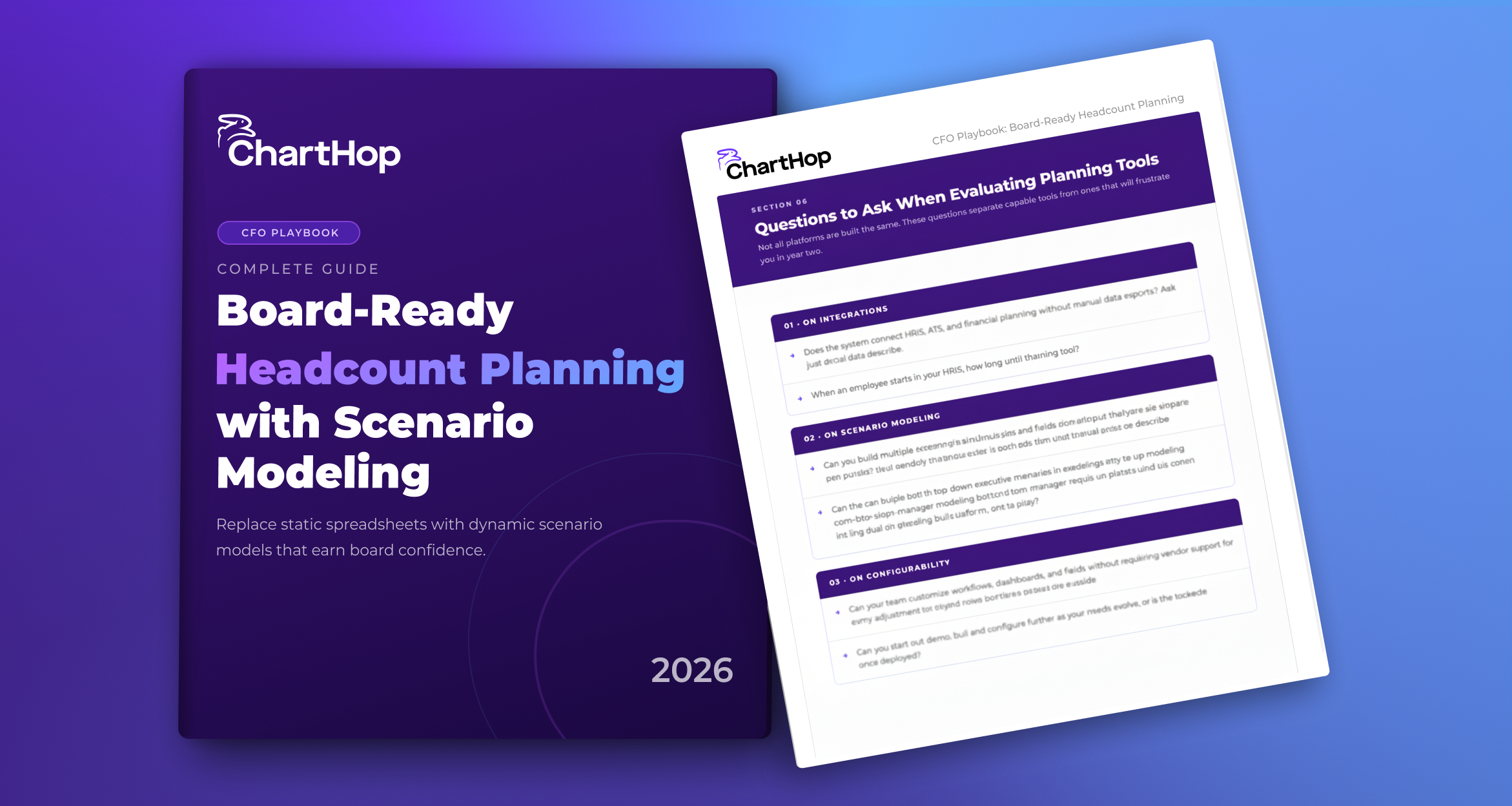
A CFO playbook for leaders who need to walk into board meetings with more than a single forecast — and leave with the board's confidence, not more questions.
See how AI-powered headcount planning helps HR and Finance teams build scenarios faster, model real-time budget impact, and make confident workforce decisions without the spreadsheets.